
There is a version of injury care where the patient is managed on escalating narcotics for a year and a half. By the time anyone reaches a deposition, the other side is no longer arguing about the collision. They are reading out a medication list.
That shift is not an accident, and it is not really about the drugs. It is about what a long opioid record lets someone argue: that the pain was managed rather than treated, that function never returned because of the treatment, and that the person in the chair is not a reliable narrator of their own body.
Why medication-only management fails the patient first
Set the claim aside for a moment, because the clinical argument comes first and it stands on its own.
An opioid does not treat an injury. It changes the perception of the signal the injury is generating. That is genuinely useful in the short term and after surgery. Sustained for months, it stops being a bridge and becomes the destination — while the thing generating the signal goes unaddressed.
Worse, the underlying terrain often continues to deteriorate. Inflammation, poor sleep and lost movement are not side issues in a stalled recovery; they are the mechanism of it, and none of them are touched by a prescription. Why the tissue is not healing
Do not start, stop, or change any medication without consulting your physician. Abrupt discontinuation of an opioid is dangerous, and nothing here is a reason to do it on your own.
What we do instead
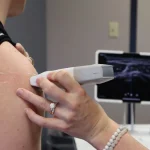
Our approach is interventional first. Find the specific structure generating the pain, treat that structure, and document what happened when it was treated.
A targeted diagnostic block is the clearest example. When a precisely placed anesthetic reliably abolishes a specific pain, and the pain returns as the block wears off, two things have been accomplished at once: the patient has relief, and the pain circuit has been demonstrated to exist and localized. That is a physiological finding rather than a report of symptoms.
We do not run medication-only management. Where opioids are used, they are a component of a plan with an exit, not the plan itself.
The numbers from our own practice
These are our practice-reported figures, not results from a clinical trial:
- 21% of patients under active interventional treatment are completely off opioid pain medication within 90 days.
- 34% are completely off opioid pain medication within one year.
- Across our established patients, fewer than 1% remain above 90 morphine milligram equivalents per day, and most who cannot come off entirely are held below 30 MME.
Practice-reported figures from our own patient population, not trial outcomes. Individual results vary.
The reason to state them at all is that they describe a direction of travel. A patient whose function is improving and whose medication burden is falling is in a different clinical position — and a different evidentiary position — than one whose dose has climbed every quarter for a year.
Why this matters to the case
A patient who is getting better is a better witness than a patient who is getting comfortable.
That is not a slogan about character. It is about what the record shows. Improving function under targeted treatment produces dated, objective evidence of an injury that responded to appropriate care. A long escalating opioid record produces something else entirely: a timeline that invites argument about dependence, motivation and credibility, and that shifts attention away from the injury and onto the patient.
The same principle runs through the rest of injury documentation. Systems that value claims discount the subjective and reward the documented — so the answer to a disputed injury is density of objective findings, not volume of assertion. How objective findings answer the malingering label
What this is not
This practice is not a source of continuing opioid prescriptions. Patients are frequently referred here to reduce an opioid burden, and that is the direction the work runs. If what is needed is continuation of an existing prescription, this is not the right referral.
It is also not a claim that opioids are never appropriate. They have a real place — short-term, post-operative, and in specific cancer and palliative contexts under co-management. The argument here is narrower: medication-only management of a traumatic injury tends to serve neither the patient’s recovery nor the accuracy of the record.
Frequently asked questions
Will taking prescribed pain medication hurt my injury claim?
What is an interventional-first approach?
What does a diagnostic block prove?
Do you prescribe opioids?
Where is Injury Experts located?
Get your injury validated by science, not by an adjuster's spreadsheet
We turn subjective pain into objective, court-ready evidence — biomarkers, biomechanics and diagnostic blocks. Bring us your case before the insurer defines it for you.
Or call (314) 887-5866 · text (314) 886-5902
Key takeaways
- Opioids alter the perception of a signal; they do not treat the structure generating it.
- Medication-only management leaves the underlying terrain — inflammation, poor sleep and lost movement — untouched, and that terrain is the mechanism of a stalled recovery.
- Interventional-first care produces objective, dated findings as a by-product of treating the structure generating the pain.
- Practice-reported: 21% fully off opioid pain medication within 90 days, 34% within one year.
- Never start, stop, or change a medication without consulting your physician.
Verified sources
- Opioid outcome figures (21% within 90 days; 34% within one year; fewer than 1% of established patients above 90 MME; most maintained below 30 MME) — practice-reported from the Padda Institute patient population. Not trial outcomes, and individual results vary. The tiers are distinct: new patients frequently arrive above 90 MME, while fewer than 1% of established patients remain there. These figures were published publicly on International Overdose Awareness Day, August 31, 2026, and carried by AP News; the original release is here.
- Diagnostic block as objective demonstration of a pain circuit — standard interventional pain practice; described here mechanistically rather than as a cited efficacy claim.