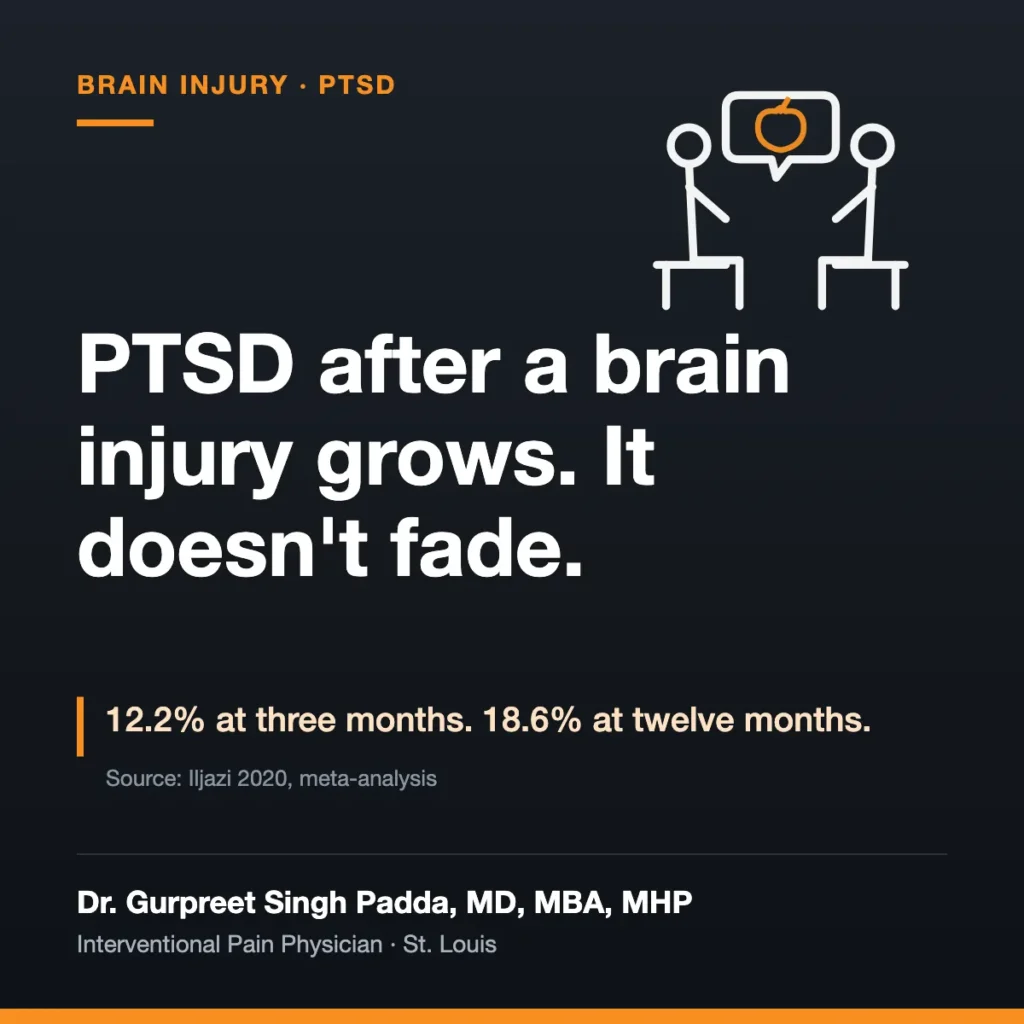
PTSD after a brain injury often gets worse with time instead of better. When researchers pooled civilian studies, post-traumatic stress disorder affected 12.2% of brain injury patients at the three-month mark and 18.6% at one year. At Injury Experts, we screen for it more than once, count sleep problems as part of the injury, and provide behavioral care here in our own clinic.
That timing catches people off guard. A sprain, a cut or a bruise usually hurts most in the first few days and then settles. Post-traumatic stress after a head injury can run the other way.
How common is PTSD after a traumatic brain injury?
A 2020 systematic review and meta-analysis combined research on civilians who had a traumatic brain injury. PTSD showed up in 12.2% of patients at three months, in 16.3% half a year in, and in 18.6% at twelve months. At the one-year point, people with a brain injury were 1.7 times as likely to have PTSD as the comparison groups.1
The authors cautioned that the studies differed a great deal from one another, so the exact percentages are rough estimates. What holds steady across the data is the direction. The numbers went up through the first year.
Why would PTSD get worse months after a crash?
Several problems stack up at the same time. A brain injury can disturb the circuits in the front of the brain that normally calm a fear response. Sleep trouble is one of the most common complaints after a concussion, and short or broken sleep keeps the body’s stress system switched on. Then daily life adds weight: time off work, bills, and a body that no longer feels reliable behind the wheel or on the stairs.
None of these has to be severe on its own. Together, over months, they can turn a frightening memory into a disorder.
What are the signs of PTSD after a car accident?
- nightmares or sudden, vivid memories of the crash
- avoiding driving, the road where it happened, or riding as a passenger
- feeling jumpy, on edge or quick to anger
- trouble falling asleep or staying asleep
- feeling numb or cut off from the people you care about
Some of these overlap with concussion symptoms, which is one reason PTSD gets missed. Irritability and poor sleep can come from either condition, or from both.
Why can an early checkup miss PTSD?
Because the diagnosis may not be there yet. A visit six weeks after the crash can find a patient who is shaken but coping. That same patient may meet the criteria for PTSD by month six. One screening done early, followed by a closed chart, is exactly how the problem slips through.
How does Injury Experts screen for and treat PTSD after a brain injury?
We do not check once and move on. We screen at the first visit and again at later visits, because the research shows the risk keeps climbing across the first year. We ask about sleep at every visit and treat it as part of the injury, not a side issue. When a patient needs behavioral care, it happens here, inside the same treatment plan, instead of through a referral to an outside office.
Our article on concussion without blacking out after a car accident explains how we evaluate the brain injury itself.
What should attorneys know about the timing of PTSD?
An injury file that closes after the first reassuring visit can miss the diagnosis that matters most at month six or month twelve. A chart that shows repeat screening, sleep findings and the date new symptoms appeared answers the question of when the condition developed and why. Our page for attorneys covers referrals and records requests.
Frequently asked questions
Can you get PTSD from a minor car accident?
Yes. PTSD depends on how the event affected you, not on the size of the dent. If you have nightmares, avoid driving, or feel constantly on guard after a crash, tell a doctor.
Is it normal to feel worse months after a brain injury?
It happens, especially with stress symptoms. In the meta-analysis, PTSD rates at one year were higher than at three months. Feeling worse later is a reason to be rechecked, not a reason to wait it out.
Does poor sleep make PTSD worse?
Poor sleep keeps the stress response running, and it is one of the most frequent complaints after a brain injury. We address sleep from the first visit.
Where is Injury Experts located?
We are at 4477 Woodson Rd, Suite 202, St. Louis, MO 63134, next to Lambert International Airport. Call (314) 887-5866, text (314) 886-5902, or schedule online.
Still not yourself months after the crash?
We screen for post-traumatic stress more than once, treat sleep as part of your care, and provide behavioral care in our own clinic.
Or call or text us.
Sources
- Iljazi A, Ashina H, Al-Khazali HM, Lipton RB, Ashina M, Schytz HW, Ashina S. Post-traumatic stress disorder after traumatic brain injury: a systematic review and meta-analysis. Neurological Sciences. 2020;41(10):2737-2746. doi:10.1007/s10072-020-04458-7 (PMID 32415640)
Written and medically reviewed by Dr. Gurpreet Singh Padda, MD, MBA, MHP — Board Certified in Anesthesiology, Pain Medicine, Interventional Pain Management, Addiction Medicine, and Obesity Medicine. Last reviewed November 24, 2026.