Yes, you can have a concussion after a car accident without ever blacking out. Passing out does not decide whether the brain was hurt, and it does not predict who will still feel sick a month later. At Injury Experts, a physician checks for the symptoms that do predict a slow recovery, follows them over time, and records how the injury affects your work.
Right after a crash, almost everyone gets asked the same thing: did you black out? When the answer is no, the conversation often stops. That is the moment the better questions should start.
Can you have a concussion without blacking out?
Yes. A concussion is a brain injury from a sudden jolt. Losing consciousness is one way it can show itself, but plenty of people with a concussion stay awake, talk to the police, and drive themselves home.
The injury happens at the level of brain chemistry. The jolt lets charged particles rush across the walls of nerve cells, and a messenger chemical called glutamate spills out. The cells then burn through energy trying to restore balance, at a time when their fuel supply is low. Scientists describe this as a metabolic crisis, and it does not depend on whether the person passed out.1
Which symptoms predict a longer concussion recovery?
A study of 1,507 college athletes with a concussion looked for the early signs that pointed to symptoms lasting four weeks or more. Blacking out was not one of them.2 These were:
- No memory of the moments just before the injury (retrograde amnesia)
- Trouble concentrating
- Sensitivity to light
- Trouble sleeping
- A concussion in the past
So we ask about every item on that list. A driver who stayed awake but cannot recall the seconds before impact, squints under office lights, and has slept badly since the crash does not have a small injury.
How can a concussion affect your job?
For working adults, the largest cost of a concussion often lands at work. The TRACK-TBI study followed 435 employed adults, ages 18 to 64, who went to one of 11 large US trauma centers after a mild brain injury.3
- At two weeks, 59% were not working.
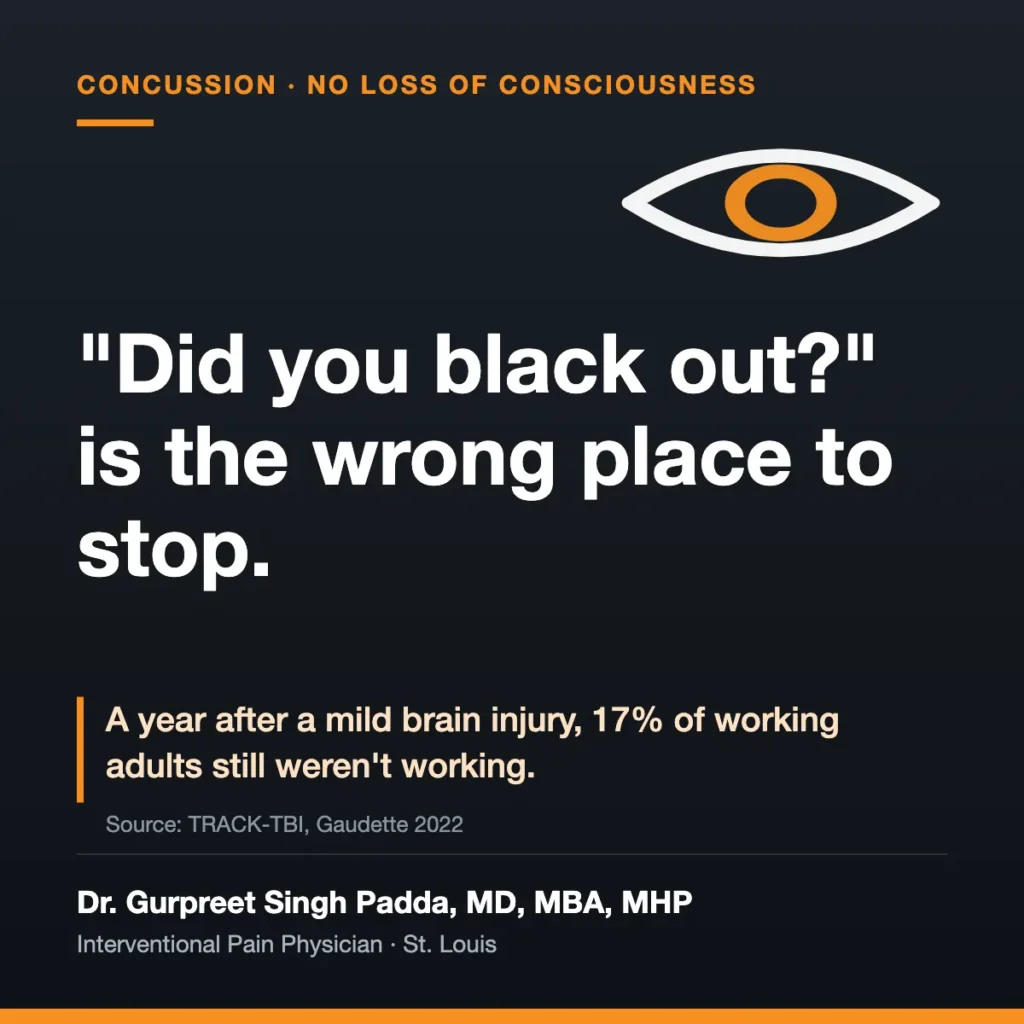
- At one year, 17% were still not working.
- More than one in five saw their yearly income fall.
The symptom count at three months mattered most. Of the people with three or more concussion symptoms at that point, 73% were working one year after the injury. Of the people with two or fewer, 89% were.3
An emergency visit happens once. Losing a job, missing a promotion, or no longer being able to do the same work can last for years. That is why our care looks well past the first week.
Why does the emergency room record often miss the brain injury?
Emergency teams look for what could harm you today, such as bleeding inside the skull. That is the right job for that day. It still leaves holes in the record. Researchers in Minnesota reviewed 1,678 head injury events from a single county. For 74% of them, the chart held no Glasgow Coma Scale score, and 49% of the patients were never given a head CT.4
A missing score is not proof of a mild injury. It only means nobody measured it. Measuring it is our job, and timing matters, as we explain in our post on when concussion testing should happen.
What helps people get back to work after a concussion?
The things that change the outcome start early and can be measured:
- Symptoms checked on a schedule. We ask at each visit and again at the three-month mark, not just once.
- Sleep treated as a real problem. Poor sleep sits on the list of warning signs, so we treat it with the same care as the headache.
- Work changes started early. In TRACK-TBI, people whose employers offered help in the first three months, such as sick leave, fewer hours, a new schedule or different tasks, were more likely to be working at one year: 86% compared with 72%.3
We write clear work notes that list what you can and cannot do, and our physician-directed physiotherapy program rebuilds balance and tolerance for activity alongside your medical care.
What should attorneys and case managers look for in a concussion record?
A line that reads “no loss of consciousness” is the first sentence of the record, not its conclusion. Check whether the warning signs above were asked about, whether symptoms were counted again at three months, and whether work status shows up at every visit. The long-range picture is covered in our post on the lifetime cost of a brain injury.
If you are an attorney or paralegal handling a crash or work injury case, our page for attorneys covers records requests and how to refer a client.
When is a head injury an emergency?
Call 911 or go straight to an emergency room if a headache is growing stronger, vomiting will not stop, the person seems confused, an arm or leg turns weak or numb, speech slurs, or staying awake becomes hard. Those signs need a scan today, not a clinic visit.
Frequently asked questions
Can you have a concussion if you did not pass out?
Yes. Passing out is one possible sign of a concussion, but it is not required. Most people with a concussion stay awake, and the brain injury is still real.
Which concussion symptoms should I tell my doctor about?
Tell your doctor if you cannot remember the moments just before the crash, have trouble focusing, find light hard to tolerate, or are sleeping poorly. Also mention any earlier concussion. These were linked to symptoms that last a month or longer.
Does a normal CT scan mean I do not have a concussion?
No. A CT scan looks for bleeding and broken bones. A concussion is a problem with how brain cells work, so a normal scan does not rule it out. Symptoms and a physician exam do that work.
Where is Injury Experts located?
We are at 4477 Woodson Rd, Suite 202, St. Louis, MO 63134, next to Lambert International Airport. Call (314) 887-5866, text (314) 886-5902, or schedule online.
Still not right since the crash?
Headaches, poor focus, light sensitivity or bad sleep after a car accident deserve a physician exam, even if you never blacked out. We check, measure and follow every symptom.
Or call or text us.
Sources
- Giza CC, Hovda DA. The new neurometabolic cascade of concussion. Neurosurgery. 2014;75 Suppl 4:S24-S33. doi:10.1227/NEU.0000000000000505 (PMID 25232881)
- Zuckerman SL, Yengo-Kahn AM, Buckley TA, Solomon GS, Sills AK, Kerr ZY. Predictors of postconcussion syndrome in collegiate student-athletes. Neurosurgical Focus. 2016;40(4):E13. doi:10.3171/2016.1.FOCUS15593 (PMID 27032916)
- Gaudette É, Seabury SA, Temkin N, Barber J, DiGiorgio AM, Markowitz AJ, Manley GT. Employment and economic outcomes of participants with mild traumatic brain injury in the TRACK-TBI study. JAMA Network Open. 2022;5(6):e2219444. doi:10.1001/jamanetworkopen.2022.19444 (PMID 35767257)
- Malec JF, Brown AW, Leibson CL, Flaada JT, Mandrekar JN, Diehl NN, Perkins PK. The Mayo classification system for traumatic brain injury severity. Journal of Neurotrauma. 2007;24(9):1417-1424. doi:10.1089/neu.2006.0245 (PMID 17892404)
Written and medically reviewed by Dr. Gurpreet Singh Padda, MD, MBA, MHP — Board Certified in Anesthesiology, Pain Medicine, Interventional Pain Management, Addiction Medicine, and Obesity Medicine. Last reviewed November 3, 2026.