The main alternatives to back surgery are image-guided interventional procedures. Diagnostic nerve blocks confirm the pain source. Epidural steroid injections treat disc-driven nerve pain. Radiofrequency ablation treats facet joint pain. It stops the signal without removing or fusing the joint.
By the time most people come in with a chronic injury, the choice has shrunk to two extremes. Keep doing the conservative care that has already failed. Or accept major surgery that feels like a leap into the dark.
Put that way, it is a poor choice. It is also an incomplete one, because it skips the whole middle of the field. That middle is targeted, image-guided interventional procedures that are neither passive nor destructive.
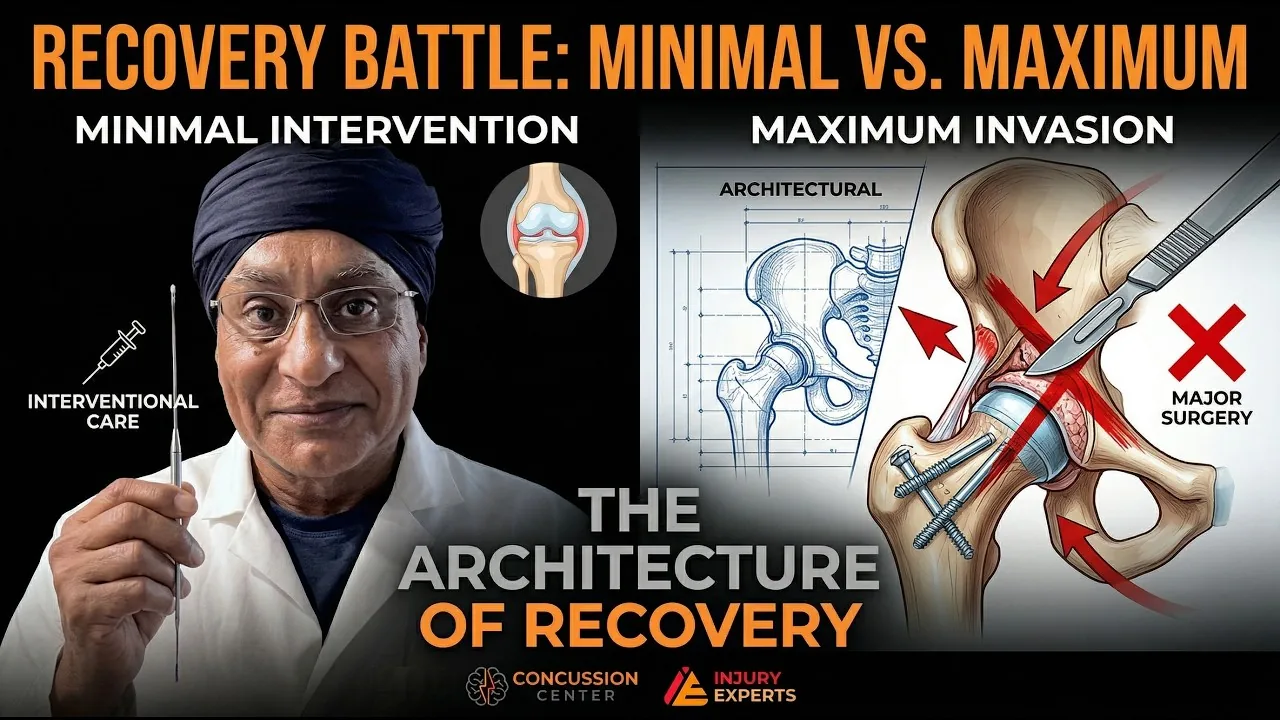
Watch on YouTube: The Architecture of Recovery: Minimal Intervention vs Maximum Invasion
Why does back surgery fail so often?
The reductionist logic is tempting. Find a structural flaw on the MRI, cut it out, problem solved. It fails often enough to have earned its own diagnosis — failed back surgery syndrome. The surgeon corrects the structural target, and the patient is still in pain.
Part of the reason is that the flaw on the film is not always the thing making the pain. Findings with no symptoms are common. The other part is biochemical. Major surgery is a heavy metabolic stress. Now picture it done on someone already carrying high systemic inflammation — elevated TNF-α, IL-6, IL-1β. It asks tissue that is struggling to maintain itself and also do a large repair. Why the terrain governs the outcome
What does a diagnostic nerve block tell you?
The most underused tool in this field is the diagnostic nerve block. Its value is not the relief it gives.
A block briefly silences one nerve or joint. That tests a hypothesis: is this the structure carrying the signal? If the pain reliably goes away and returns as the anesthetic wears off, you have found the circuit. If it does not, you have just ruled out a costly, permanent guess for very little.
This is why it belongs before any permanent intervention. Confirm the signal, then commit.
Which procedures are alternatives to back surgery?
Epidural steroid injection (ESI). With a herniated disc, pain is rarely just pressure. Disc material sets off a chemical inflammatory cascade around the nerve root. Much of the pain is that chemistry, not the squeeze itself. Think of an ESI as a targeted anti-inflammatory treatment aimed at that cascade. Recovery from the procedure is measured in hours.
Honest framing: epidural steroid injections generally give real short- to medium-term relief in radicular pain (pain that runs down the nerve). The benefit often fades over months. They open a window in which rehab can happen. They are not a permanent cure.
Radiofrequency ablation (RFA). For facet-mediated joint pain, RFA uses heat to interrupt the small medial branch nerves that carry the pain signal. The relevant contrast with fusion is structural: RFA stops the signal without removing or immobilizing the joint. You keep your motion. That matters, because movement is one of the few lasting levers on metabolic health. Nerves grow back, so the effect lasts a long time but is not permanent. The procedure can be repeated.
Both are used with fluoroscopic or high-resolution ultrasound guidance for precise placement, and are performed without sedation — which has a practical advantage, since an awake patient can report sensory and motor responses in real time.
Complex regional pain syndrome
CRPS deserves its own mention because it is so often mishandled. Diagnosis should follow the Budapest criteria, the accepted standard.
The key point: in established CRPS, the problem has moved into the central nervous system. The nervous system has lost its normal self-control. This is why amputation of an affected limb rarely ends CRPS. Removing the limb does not address a pain state the brain and spinal cord now keep running. Treatment has to target the nervous system, not only the painful part.
The opioid trap
Long-term opioid therapy can produce opioid-induced hyperalgesia, in which the pain system becomes more sensitive over time. At the same time, the body’s own pain relief systems are turned down. The result is a patient on rising doses with worsening pain. This is a well-described problem. It is one of the strongest arguments for targeted treatment over endless medication.
Never change or stop opioid medication on your own. Withdrawal carries real risks and needs a physician watching over it.
What decides whether a spine procedure works?
A procedure is only as good as the body it is done on. Where insulin resistance and systemic inflammation are present, a well-placed injection is still fighting the setting it sits in. That is why measuring the biological terrain matters. Markers such as hs-CRP, TNF-α, and lipid particle measures are not an add-on to the procedure. They decide whether the procedure holds.
Where a biologic injection fits next to these procedures is now a written question, not an open one. The societies graded it between 2024 and 2026. What those guidelines say, and where the evidence runs against them.
Related reading: comprehensive pain management in St. Louis and specialized pain care after an accident.
Many of our patients start with our physician-directed physiotherapy program: heat, traction, laser, gentle electrical stimulation and other treatments that a physician orders and supervises, for as many visits as the injury needs, with progress measured at each re-check.
Frequently asked questions
What are the alternatives to back surgery?
Image-guided interventional options include diagnostic nerve blocks to find the pain generator. Epidural steroid injections treat inflammatory radicular pain. Radiofrequency ablation treats facet-mediated pain. All of this goes alongside rehab and care of the underlying metabolic drivers.
What is failed back surgery syndrome?
Pain that persists or comes back after a technically successful spinal surgery. It happens partly because the structural finding was not the true pain generator. It also happens because the body’s biology did not support healing.
How long does radiofrequency ablation last?
Relief usually lasts for months but is not permanent, because the treated nerves grow back over time. The procedure can generally be repeated. Results vary from person to person.
Is an epidural steroid injection a cure?
No. Think of it as targeted anti-inflammatory treatment that eases radicular pain for a while. That opens a window for rehab. The benefit often fades over months.
Why would a procedure be done without sedation?
Staying awake allows real-time sensory and motor feedback during needle placement, which supports accuracy. Injections and blocks here use no sedation, so most patients drive themselves home, and normal activity, including work, resumes within two to four hours. If an arm or leg feels weak or numb, have someone else drive until that wears off.
Is it best to avoid back surgery?
Surgery should never be a guess. MRI findings are common in people with no symptoms, so the flaw on the film is not always the pain source. When it is removed and the pain stays, the result is failed back surgery syndrome. A diagnostic nerve block tests the target first. Procedures such as epidurals and radiofrequency ablation come before anything permanent. Confirm the signal, then commit.
Where is Injury Experts located?
Injury Experts is at 4477 Woodson Rd, Suite 202, St. Louis, MO 63134, next to Lambert International Airport, serving the St. Louis region in Missouri and Illinois. Call (314) 887-5866 or text (314) 886-5902.
Get your injury validated by science, not by an adjuster's spreadsheet
We turn subjective pain into objective, court-ready evidence — biomarkers, biomechanics and diagnostic blocks. Bring us your case before the insurer defines it for you.
Or call or text us.
Key takeaways
- Between failed conservative care and major surgery sits targeted interventional treatment.
- A diagnostic block confirms the pain generator before anything permanent.
- RFA interrupts the signal and keeps the joint and its motion.
- CRPS is kept running by the central nervous system. The Budapest criteria guide diagnosis, and amputation does not end it.
- Opioid-induced hyperalgesia can make long-term opioid therapy backfire.
Sources
- Cohen SP, Bhaskar A, Bhatia A, et al. Consensus practice guidelines on interventions for lumbar facet joint pain from a multispecialty, international working group. Reg Anesth Pain Med. 2020;45(6):424–467. doi:10.1136/rapm-2019-101243 (PMID 32245841)
- Chou R, Loeser JD, Owens DK, et al. Interventional therapies, surgery, and interdisciplinary rehabilitation for low back pain: an evidence-based clinical practice guideline from the American Pain Society. Spine. 2009;34(10):1066–1077. doi:10.1097/BRS.0b013e3181a1390d (PMID 19363457)
- Brinjikji W, Luetmer PH, Comstock B, et al. Systematic literature review of imaging features of spinal degeneration in asymptomatic populations. AJNR Am J Neuroradiol. 2015;36(4):811–816. doi:10.3174/ajnr.A4173 (PMID 25430861)
- Chu LF, Clark DJ, Angst MS. Opioid tolerance and hyperalgesia in chronic pain patients after one month of oral morphine therapy: a preliminary prospective study. J Pain. 2006;7(1):43–48. doi:10.1016/j.jpain.2005.08.001 (PMID 16414554)
This article is for general education and is not medical advice. It does not create a physician–patient relationship. Do not start, stop, or change any medication — including opioid medication — without consulting your physician.
Medically reviewed by Dr. Gurpreet Singh Padda, MD, MBA, MHP — Board Certified in Anesthesiology, Pain Medicine, Interventional Pain Management, Addiction Medicine, and Obesity Medicine.