Delayed pain after a car accident is the expected course for many injuries, not a warning sign that someone is exaggerating. In the first hours, the nervous system turns pain down. Over the next days, inflammation builds. Weeks later, when you start using the injured part again, injuries that were quiet at rest begin to hurt. Pain that arrives late is often pain that was always coming.
How does the body turn pain off after a crash?
In 1965, Ronald Melzack and Patrick Wall proposed the gate control theory of pain.1 Pain signals from an injury do not travel straight to the brain. They pass through a checkpoint in the spinal cord, in an area called the dorsal horn. That checkpoint works like a gate. Some inputs open it wider. Others close it.
Two things close the gate hard after a crash:
- Signals coming down from the brain. In an emergency, the brain sends signals down the spinal cord that block pain at the gate. Adrenaline rises, and the brain releases its own opioid-like chemicals. This is called stress-induced analgesia, and how strong it is varies a lot from person to person.2
- Competing input. Touch, pressure and movement travel on fast nerve fibers that partly close the gate. This is why you rub a bumped elbow, and it is the idea behind TENS units.
There is also attention. A broken bone, a bleeding wound or a frightened passenger takes up all of it. The quieter injuries wait.
How common is it to feel no pain at first?
More common than most people expect. In a study at a Montreal emergency department, researchers interviewed 138 injured patients who were alert and clear-headed. Fifty-one of them, 37%, said they felt no pain at the moment they were hurt. Most of those felt pain within the hour, but for some the delay ran nine hours or longer.3
The same researchers asked how the patients felt about their injuries. The main emotions were embarrassment at seeming careless and worry about losing wages. Not a single patient described the injury as something they might profit from.3 A pain-free stretch after an injury is ordinary human biology.
The extreme case comes from World War II. Henry Beecher found that many badly wounded soldiers did not ask for pain relief at all.4 The wounds were real. The brain had turned the volume down.
Why does pain show up days or weeks later?
The gate does not stay closed. Stress hormones fall over hours to days. As they fall, three things take their place.
Inflammation builds. Damaged tissue releases chemicals that make nerve endings more sensitive. Swelling and stiffness usually peak a few days after the injury, not on day one.
The nervous system becomes more sensitive. Pain signals that keep arriving can turn up the gain at the spinal checkpoint, so the same injury hurts more over time.
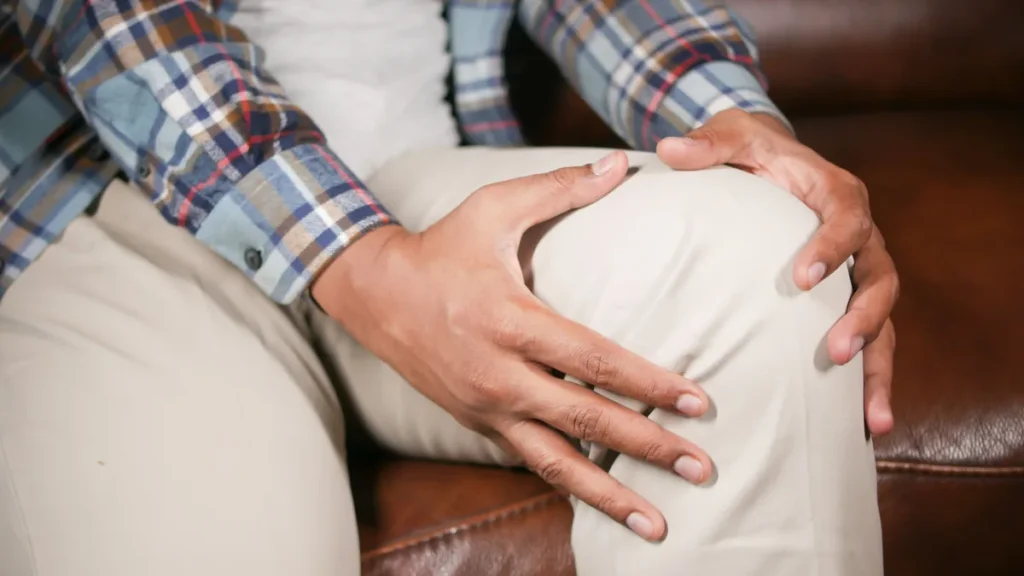
You start loading the injury. This is the part people underestimate. A torn meniscus, a torn hip labrum or a loose knee ligament may hurt very little while the leg rests in a boot or you stay in bed. It starts to hurt the first week you walk, climb stairs, or turn on a planted foot. Nothing about the injury changed. You asked it to work.
That is what happened to me after my October crash. The fractures got the attention on day one. Two weeks after the crash I was fully active again. With my whole weight on that leg every day, the knee ligament and meniscus, the hip labrum, the scarred calf and an irritated lumbar nerve root each surfaced, one after another, in the weeks that followed. The order was what the biology predicts.
Which delayed symptoms after a car accident need attention?
- A knee that gives way, locks or catches
- Groin or deep hip pain when you walk, sit, or put on shoes
- Pain, numbness or tingling that runs down an arm or a leg
- Headache, poor focus, light sensitivity or poor sleep that build after the first days
- Neck or low back pain that worsens instead of easing
- A calf or forearm that stays tight, weak or numb
Call 911 or go to the ER for new weakness, loss of bladder or bowel control, a cold or pale limb, chest pain, trouble breathing, or a headache that keeps getting worse.
Brain symptoms have their own timeline, covered in concussion without blacking out. Why the first scan didn’t show these injuries is in why the ER CT scan can miss an injury. For what “soft tissue” covers in the first place, start with soft tissue injury after a car accident; for how a delayed finding is documented, see the gap-in-treatment page.
Does closing the gate help with treatment?
Yes. The same physiology that hides pain early can be used on purpose later. TENS, vibration and guided movement send signals on the fast fibers that help close the gate, which is why they are part of our physician-directed physiotherapy program. They let you keep moving while the deeper injury is diagnosed and treated. They do not replace the diagnosis.
Frequently asked questions
Is it normal to feel pain days after a car accident?
Yes. Stress hormones and the brain’s own pain blockers can hide pain for hours. Inflammation builds over days, and injuries such as meniscus or labral tears may only hurt once you start walking on them again.
How long can pain be delayed after an accident?
Hours for some people, weeks for others. More than a third of clear-headed ER patients in one study had a pain-free stretch right after the injury. Tears that mainly hurt under load can wait until you are back on your feet.
What is the gate control theory of pain?
It is the idea, proposed by Melzack and Wall in 1965, that pain signals pass through a gate in the spinal cord. Signals from the brain and from touch or movement can close the gate and turn pain down. That helps explain why pain can be absent right after an injury and appear later.
Where is Injury Experts located?
We are at 4477 Woodson Rd, Suite 202, St. Louis, MO 63134, next to Lambert International Airport. Call (314) 887-5866, text (314) 886-5902, or schedule online.
New pain since the crash?
Pain that starts days or weeks later is common and real. We examine it, find which tissue is involved, and treat it.
Or call or text us.
Sources
- Melzack R, Wall PD. Pain mechanisms: a new theory. Science. 1965;150(3699):971-9. doi:10.1126/science.150.3699.971 (PMID 5320816)
- Butler RK, Finn DP. Stress-induced analgesia. Progress in Neurobiology. 2009;88(3):184-202. doi:10.1016/j.pneurobio.2009.04.003 (PMID 19393288)
- Melzack R, Wall PD, Ty TC. Acute pain in an emergency clinic: latency of onset and descriptor patterns related to different injuries. Pain. 1982;14(1):33-43. doi:10.1016/0304-3959(82)90078-1 (PMID 7145438)
- Beecher HK. Pain in Men Wounded in Battle. Annals of Surgery. 1946;123(1):96-105. PMC1803463 (PMID 17858731)
Written and medically reviewed by Dr. Gurpreet Singh Padda, MD, MBA, MHP — Board Certified in Anesthesiology, Pain Medicine, Interventional Pain Management, Addiction Medicine, and Obesity Medicine. Last reviewed November 5, 2026.