Get concussion blood testing within hours, not days. UCH-L1 peaks around 8 hours and falls over about 48 hours. GFAP peaks near 20 hours and stays useful for about 7 days.
Most people hurt in a crash do not think about testing for days. They go home and wait to feel better. They look for answers only when the fog does not lift.
By then some of the best evidence is already gone. That is not because anyone disbelieved them. It is because certain markers clear from the blood on a schedule. That schedule does not wait for anyone to decide the symptoms are serious enough.
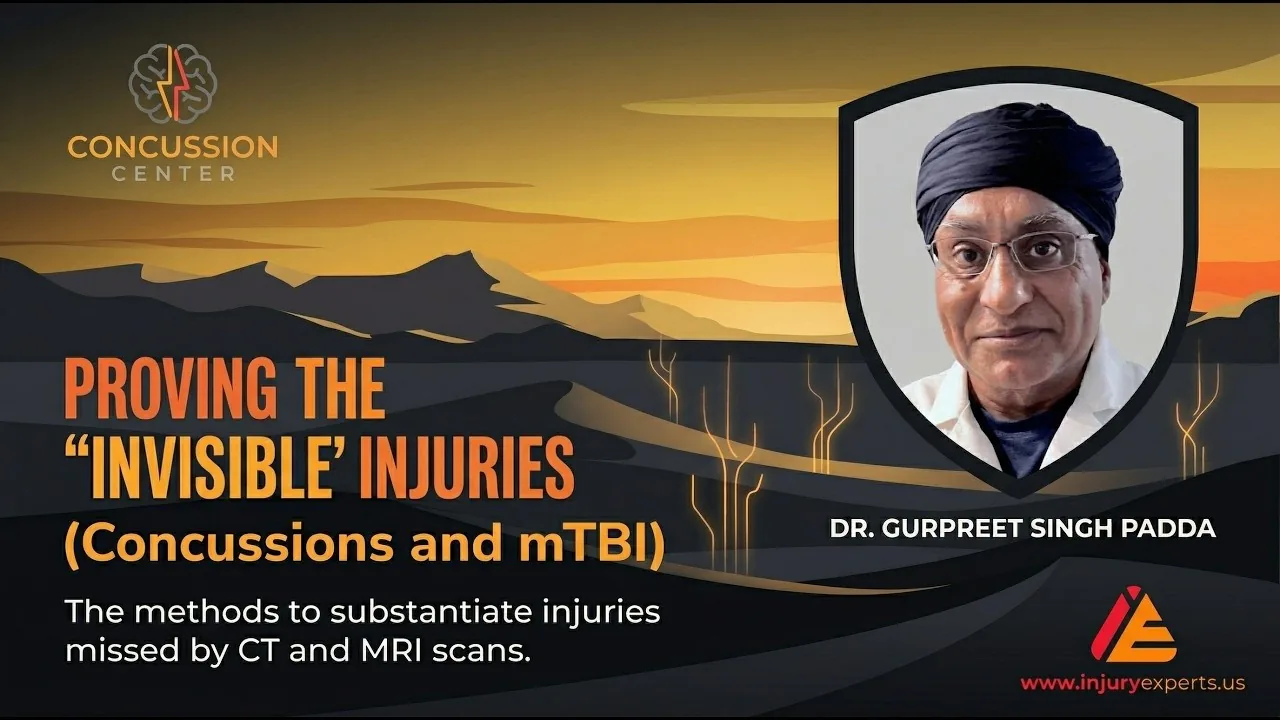
Watch on YouTube: Proving the Invisible & Architecting Regeneration
Why doesn’t a concussion show up on a CT or MRI?
CT and MRI answer one question well: is there a fracture or a bleed? Mild traumatic brain injury is mostly a microscopic event. Nerve fibers (axons) get stretched and torn, and the hurt tissue cannot get the energy it needs to repair. Standard brain scans are not built to see that.
This gap is where claims get denied: if it is not on the scan, it is not real. Two kinds of testing close the gap.
How long after a head injury does a concussion blood test work?
Since 2018, blood markers have let us measure stress inside brain cells. Two matter most acutely, and their timing differs in a way that changes what you should do:
| Marker | Source | Rises | Peak | Useful window |
|---|---|---|---|---|
| UCH-L1 | neuronal cell bodies | rapidly | ~8 hours | declines rapidly over ~48 hours |
| GFAP | astrocytes (glial) | rapidly | ~20 hours | declines slowly over ~72 hours; performs across 7 days |
The result is stark. UCH-L1 is a hyperacute signal — wait two days and the window has closed. GFAP is the more forgiving marker. It stays useful for people who seek care later in the week.
The combined GFAP/UCH-L1 panel is used mainly to rule out injury, and here the evidence is strong. The ALERT-TBI study (Bazarian et al., The Lancet Neurology, 2018) found a sensitivity of 0.976 and a negative predictive value of 0.996 for injuries inside the skull seen on CT. The authors estimated that routine use could reduce CT scans by about a third.
Read that correctly, because people often misread it. A very high negative predictive value means a negative result is strong evidence against the injury being checked for. It does not mean a positive result proves a specific diagnosis or predicts your recovery.
Bedside machines can return these results in about fifteen minutes. That speed lets the doctor decide right away whether a CT, with its heavy radiation, is needed at all.
Longer-horizon and rule-out markers
Neurofilament light (NfL) lasts for months. It reflects ongoing axonal degeneration (nerve fibers breaking down) rather than the acute event.
S100B is used in Europe, mainly under the Scandinavian guidelines, to rule out injury and skip needless scans. The cutoff is 0.1 µg/L in serum. Its negative predictive value is about 98%. Its sensitivity for damage inside the skull is about 90%. Its specificity is low, about 30–50%. In plain terms, a normal S100B is reassuring. A high one does not, on its own, diagnose much.
After the acute phase, TBI acts like a chronic inflammatory process. Alarm signals such as HMGB1 can set off a second wave of injury. Ongoing neuroinflammation comes from immune and support cells in the brain (microglia and astrocytes) that stay switched on. That is why symptoms can go on long after the crash. It is also why the inflammatory terrain is worth measuring. More on that terrain
What imaging can show a concussion when the CT is normal?
Diffusion tensor imaging (DTI) checks the wiring of the brain, the white-matter tracts, by measuring how water moves along them. fractional anisotropy is the number most often reported. It can find damage where a standard MRI shows nothing.
Around 30% of patients with a normal CT show lesions when more sensitive MRI or DTI sequences are used.
How do doctors test brain function after a concussion?
Scans and blood tests describe structure and chemistry. Thinking tests (neurocognitive testing) measure performance. That is often what the person actually lost.
- SAC (Standardized Assessment of Concussion) — quick data on orientation and memory.
- SCAT — a set exam that covers symptoms, balance and coordination.
- Computerized testing (e.g. ImPACT) — processing speed and reaction time measured against normal scores. It picks up changes a person could not reliably fake in either direction.
Emerging work in cortical physiology — sensorimotor peak alpha frequency and cortical motor excitability measured via EEG and TMS — is being studied as a way to predict who will transition from acute to chronic pain.
Two myths worth retiring
“You must lose consciousness to have a concussion.” This is false. Most concussions happen without passing out, and passing out is not required for the diagnosis.
“If you felt fine that day, you were fine.” Nausea, ringing in the ears (tinnitus), headache and brain fog can show up over the next few days. Late symptoms are common. They are not evidence that the symptoms are unrelated.
On treatment claims
The video describes a peptide-based plan sorted into groups. It also mentions changes in the legal status of several peptides.
Anything in this group should be discussed one on one with a physician. That talk should be frank about what is known, what is not, and what it costs.
Do not start, stop, or change any medication, supplement, or peptide without consulting your physician.
Memory and balance testing (Cognivue and VNG) can be ordered as part of our physician-directed physiotherapy program, and each test is tracked until it is done.
Frequently asked questions
How soon do I need a concussion blood test?
As soon as you can. UCH-L1 peaks around 8 hours and usually clears within about 48 hours. So the window for that marker is short. GFAP peaks near 20 hours and works well for about seven days.
Is it too late if I was injured a week ago?
The acute blood markers may no longer tell us much, but that does not end the matter. Advanced scans, thinking tests, longer-lasting markers such as NfL, and written records of lost function are all still available.
Do I need to have lost consciousness?
No. Loss of consciousness is not required for a concussion diagnosis. It happens in only a minority of cases.
What does a negative predictive value of 99.6% mean?
Among people who test negative, the condition being checked for is very rarely there. So a negative result is strong reassurance. It does not mean a positive result proves a specific injury. A doctor has to interpret a positive result.
Are these tests covered by insurance?
Often not, even though some have FDA clearance. Insurers decide coverage apart from that clearance, so ask about cost ahead of time.
How do doctors confirm you have a concussion?
By combining several kinds of evidence, because a standard CT or MRI is built to find fractures and bleeds, not microscopic injury. Blood markers such as GFAP and UCH-L1 measure stress in brain cells in the first hours and days. Diffusion tensor imaging can show white-matter damage when a standard MRI is silent. Thinking tests such as SAC, SCAT and ImPACT measure memory, balance and processing speed.
Would a brain bleed show up in bloodwork?
The GFAP and UCH-L1 blood panel is used mainly to rule out bleeding and other damage that would show on a CT. A negative result is strong evidence against it: the ALERT-TBI study reported a negative predictive value of 0.996. A positive result does not prove a bleed or a specific diagnosis. It means more testing, and often a CT, is needed.
How can you tell if it is a concussion or a brain bleed?
A CT answers the bleed question well: is there a fracture or a bleed? A concussion is mostly a microscopic event. Nerve fibers (axons) get stretched, and the hurt tissue runs short of energy. A CT is not built to see that. Seek emergency care right away for a worsening headache, repeated vomiting, seizures, weakness or increasing confusion.
Where is Injury Experts located?
Injury Experts is at 4477 Woodson Rd, Suite 202, St. Louis, MO 63134, next to Lambert International Airport, serving the St. Louis region in Missouri and Illinois. Call (314) 887-5866 or text (314) 886-5902.
Get your injury validated by science, not by an adjuster's spreadsheet
We turn subjective pain into objective, court-ready evidence — biomarkers, biomechanics and diagnostic blocks. Bring us your case before the insurer defines it for you.
Or call or text us.
Key takeaways
- UCH-L1 clears in about 48 hours. GFAP can be found for up to about a week.
- The GFAP/UCH-L1 panel mainly rules injury out. It is not a positive diagnosis.
- DTI can show white-matter damage when a standard MRI is silent.
- Thinking tests measure performance against normal scores.
- Loss of consciousness is not required, and symptoms often start late.
Sources
- Papa L, Brophy GM, Welch RD, et al. Time course and diagnostic accuracy of glial and neuronal blood biomarkers GFAP and UCH-L1 in a large cohort of trauma patients with and without mild traumatic brain injury. JAMA Neurol. 2016;73(5):551–560. doi:10.1001/jamaneurol.2016.0039 (PMID 27018834)
- Bazarian JJ, Biberthaler P, Welch RD, et al. Serum GFAP and UCH-L1 for prediction of absence of intracranial injuries on head CT (ALERT-TBI): a multicentre observational study. Lancet Neurol. 2018;17(9):782–789. doi:10.1016/S1474-4422(18)30231-X (PMID 30054151)
This article is for general education and is not medical advice. It does not create a physician–patient relationship. Do not start, stop, or change any medication, supplement, or peptide without consulting your physician. After a head injury, seek emergency care immediately for worsening headache, repeated vomiting, seizures, weakness, or increasing confusion.
Medically reviewed by Dr. Gurpreet Singh Padda, MD, MBA, MHP — Board Certified in Anesthesiology, Pain Medicine, Interventional Pain Management, Addiction Medicine, and Obesity Medicine.