After a car accident, an interventional pain doctor is the one who confirms where neck pain comes from. We are physicians. We examine you, read your imaging against that exam, and then test the suspected source with image-guided diagnostic blocks. A chiropractor can help you move and feel better, but a chiropractor does not prove which structure in your neck is generating the pain.
That difference sounds technical. It is not. It decides whether your treatment is aimed at the right target, and later it decides whether anyone believes the record.
What is the difference between an interventional pain doctor and a chiropractor?
A chiropractor works mostly with the hands: adjustments, stretching and exercise. Many crash patients feel looser after those visits, and that has real value.
An interventional pain doctor is a medical doctor with added training in finding and treating the sources of pain. At Injury Experts that means a physician takes your history, examines your neck and nerves, orders and reads imaging, and places needles under live X-ray or ultrasound guidance when a question needs a hard answer. We diagnose first. Then we treat what we found.
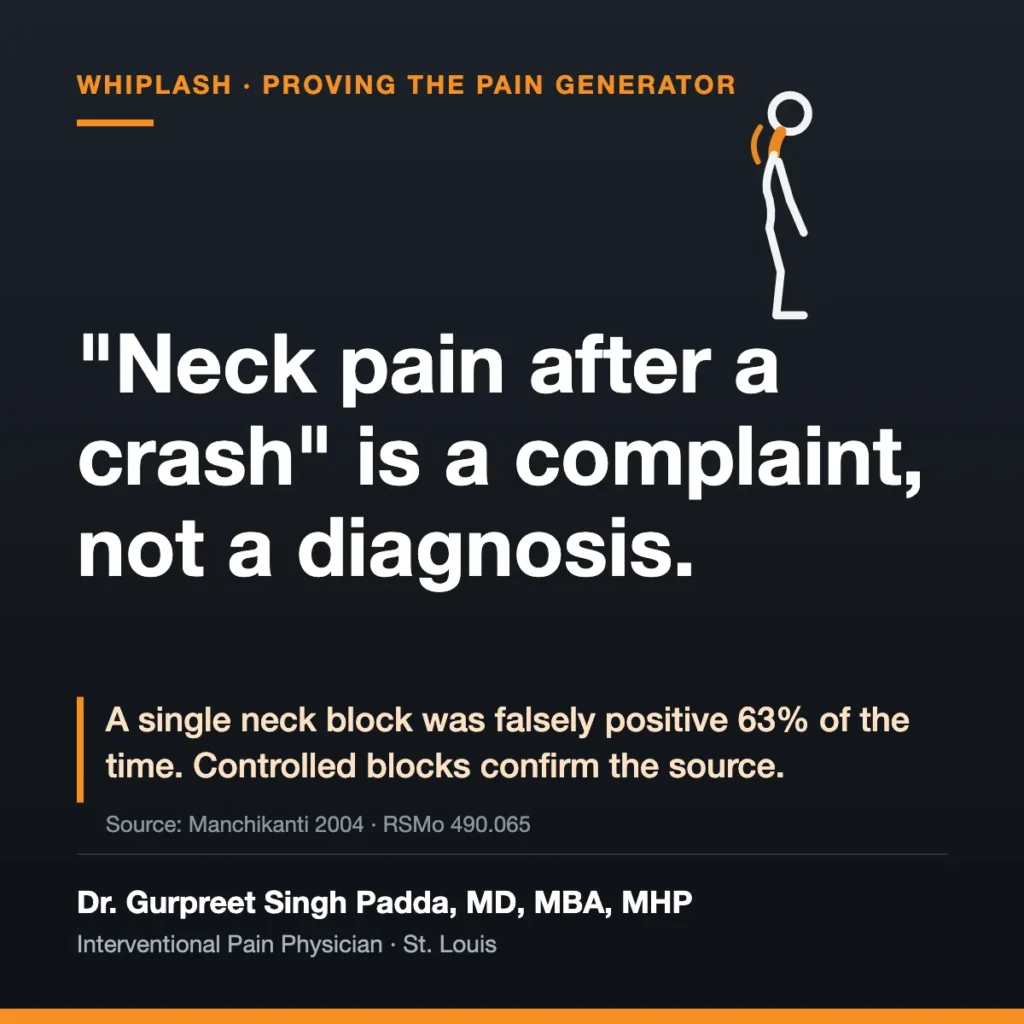
Why is “neck pain after a crash” not a diagnosis?
Because it only says where you hurt. It does not say what hurts. Your neck has discs, muscles, ligaments, nerve roots and small paired joints along the back of each bone, called facet joints. Each one can hurt after a collision, and each one is treated in a different way.
Imaging rarely settles it. A scan can look normal in a neck that hurts every day, and it can show wear in a neck that feels fine. So the scan gets read against your exam, not used in place of it.
Where does neck pain after a rear-end collision often come from?
Very often, the facet joints. When a car is hit from behind, the neck is thrown before the muscles have time to tighten. That sudden motion stretches the capsules wrapped around the facet joints. The tiny nerves that serve those joints can become sensitized, and they keep firing long after the crash. The pain is real. It has a specific address.
How often is that address the facet joints? A study of 500 patients with chronic spine pain, seen at a US interventional pain practice, tested this with controlled diagnostic blocks. Among the patients with chronic neck pain, the facet joints were the source in 55%.1
Notice who those patients were and how the answer was found. They were people with long-lasting pain at a pain practice, and the answer came from blocks, not from a scan.
Why doesn’t one injection that helped prove the source?
Because one numbing shot fools people far too often. In that same study, one block on its own was wrong 63% of the time in the neck.1 The patient felt relief, yet the joint was not the true source. Hope, the needle itself and the normal ups and downs of pain can all produce relief that has nothing to do with the joint.
So we do not trust one block. A controlled block works like this:
- We numb the small nerves to the suspected joint under image guidance, with one local anesthetic.
- On a separate day, we repeat it with a different anesthetic that lasts a different length of time.
- You record your relief hour by hour after each one.
- The joint counts as the source only when both blocks bring relief, and each one lasts about as long as that drug should last.
That pattern is hard to fake by accident. It is the closest thing medicine has to a confession from the joint.
What goes in your chart at Injury Experts?
Four things, every time:
- The exam, with your scans compared to what we find with our hands.
- Image-guided, controlled blocks, plus an hourly log of your relief.
- Function checked before and after, such as sleep, turning your head to drive, and sitting through a workday.
- The reasoning that links all three back to the crash.
Once the source is confirmed, treatment has a target. The block buys a window of less pain, and that window gets used. Moving again, sleeping through the night and rebuilding neck strength are part of the plan, not an afterthought. Our physician-directed physiotherapy program runs alongside the procedures for that reason.
Why does this matter for an injury claim in Missouri?
For patients, a clear diagnosis means care aimed at the right spot. For families and attorneys, it means the record can stand up.
In 2017 Missouri changed its rule for expert testimony. Under RSMo 490.065, expert testimony has to be grounded in enough facts or data, be the product of reliable principles and methods, and show those methods were reliably applied to this case.2 A chart that says “neck pain after a rear-end collision” gives an expert very little to stand on. A chart with an exam, controlled blocks, timed relief and measured function gives the expert something to work with.
If you handle injury cases, ask each treating provider how the source of the pain was confirmed.
If you are an attorney or paralegal handling a crash case, our page for attorneys covers records requests, the Missouri lien and how to refer a client.
Where does chiropractic care fit after a car accident?
Chiropractic care has a place in recovery. You can keep seeing your chiropractor while we work out the source, and gentle, guided movement helps a stiff neck. We are not asking anyone to choose sides.
The question is who does which job. Pinning down the source of the pain is a job for a physician, because it takes a medical exam, imaging and image-guided procedures. When the source is known, everyone on the care team is working on the same problem. Read more about our whiplash injury doctor care and our full car accident injury treatment.
Frequently asked questions
Should I see a chiropractor or a pain doctor after a car accident?
If neck pain lasts beyond the first weeks, or comes with headaches, arm pain, numbness or weakness, see a physician who can examine you, read your imaging and test the source. You can still see a chiropractor for movement and comfort while that happens.
What is a controlled diagnostic block?
It is a pair of image-guided numbing injections given on separate days with two different local anesthetics. The joint is confirmed as the source only when both bring relief that matches how long each drug lasts.
Can an X-ray or MRI show where whiplash pain comes from?
Not by itself. Imaging can rule out fractures and other serious problems, but a sore facet joint often looks normal on a scan. A properly run block is how the source gets confirmed.
Where is Injury Experts located?
We are at 4477 Woodson Rd, Suite 202, St. Louis, MO 63134, next to Lambert International Airport. Call (314) 887-5866, text (314) 886-5902, or schedule online.
Neck pain since the crash?
Bring your imaging and any records from earlier visits. A physician will examine you, find out which structure is hurting, and build the plan around it.
Or call or text us.
Sources
- Manchikanti L, Boswell MV, Singh V, Pampati V, Damron KS, Beyer CD. Prevalence of facet joint pain in chronic spinal pain of cervical, thoracic, and lumbar regions. BMC Musculoskeletal Disorders. 2004;5:15. doi:10.1186/1471-2474-5-15 (PMID 15169547)
- Missouri Revised Statutes, section 490.065: expert witness testimony (as amended 2017, HB 153). revisor.mo.gov
Written and medically reviewed by Dr. Gurpreet Singh Padda, MD, MBA, MHP — Board Certified in Anesthesiology, Pain Medicine, Interventional Pain Management, Addiction Medicine, and Obesity Medicine. Last reviewed October 30, 2026.