
There was a time when a physician could take the stand, describe thirty years of practice, and have that experience carry the weight of evidence. That time has passed.
Under the Daubert standard, expert testimony must rest on scientifically valid reasoning and a reliable methodology that the court can examine. Experience is context. Method is what survives cross-examination. In a skeptical courtroom, an opinion offered without a traceable method is an opinion the other side will ask the judge to exclude.
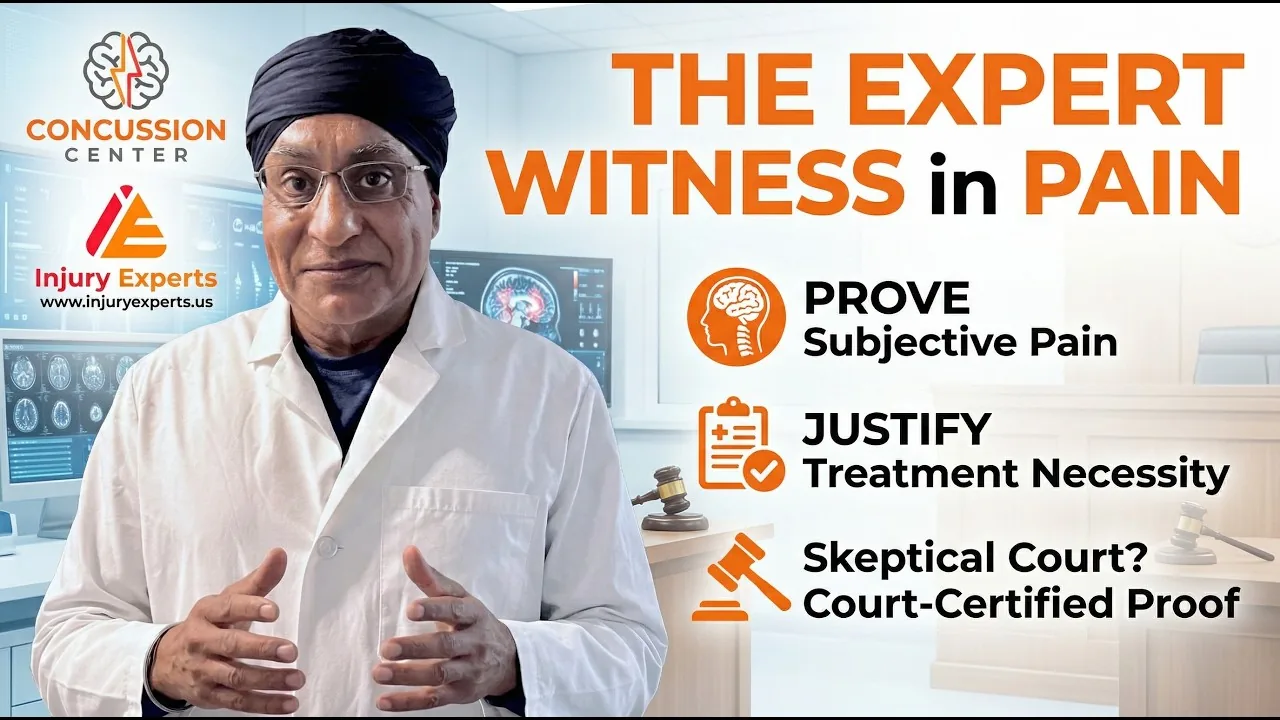
Watch on YouTube: The Role of the Expert Witness in Pain Management
Why a symptom-focused clinician struggles on the stand
Most physicians are trained to treat, not to prove. That is a reasonable division of labor until a case turns on causation, and the treating clinician is asked a question the medical record was never built to answer: did this event cause this condition, and how do you know?
The problem compounds when the standard workup comes back unremarkable. A clinician who stops at a normal imaging report has nothing left to testify about. The defense knows this, and builds around it.
The trap of the normal MRI
The most effective defense argument in soft-tissue and brain-injury litigation is also the least scientific: the image is clear, therefore there is no injury.
This reasoning fails because it assumes injury must be visible as structural disruption on a static image. A great deal of injury is not. Trauma triggers a systemic inflammatory response — the release of cytokines including TNF-α, IL-6 and IL-1β — that lowers pain thresholds and sensitizes the nervous system. Over time this can produce central sensitization, a state in which the nervous system itself amplifies signals, so that ordinary movement or light touch registers as significant pain.
Central sensitization is a well-described phenomenon in the pain literature. It is also, crucially, a functional change. It does not appear as a shadow on a conventional MRI, which is precisely why an expert who can only read images has nothing to say about it.
What objective evidence actually looks like
The task of the medical expert is to convert subjective suffering into evidence that can withstand scrutiny. Several categories do that work:
Chemical evidence. Cytokine analysis documents the inflammatory response associated with injury, rather than relying on the patient’s description of it.
Biomechanical analysis. Kinetic energy has to go somewhere. When a vehicle frame does not crumple, the energy that would have deformed steel was instead transmitted into the occupant. Low property damage is therefore not evidence of low occupant loading — in some configurations it points the other way.
Diagnostic blocks. A targeted anesthetic block that reliably abolishes a specific pain is a physiological test, not a self-report. A positive, repeatable response is objective evidence that the pain circuit exists and can be anatomically localized.
Translating the eggshell plaintiff rule into biology
Insurers routinely raise pre-existing conditions as a shield: this person was already unwell, so the collision cannot be blamed. The legal answer is the eggshell plaintiff doctrine — a defendant takes the plaintiff as found.
The medical answer is more interesting, and more persuasive to a jury. A person with a primed inflammatory system is not merely fragile in the abstract; they are biologically predisposed to a disproportionate response. A trauma in that setting can act as a match in a room already filled with fumes, initiating central sensitization that would not have followed the same event in a different body. Pre-existing vulnerability explains the severity of the outcome rather than excusing the cause of it.
Justifying medical necessity
An expert is also asked why advanced treatment was reasonable — why radiofrequency ablation or targeted injections rather than a prescription and time.
The argument is mechanistic. Managing injury-driven chronic pain with opioids while leaving the underlying inflammatory and structural problem untouched is like silencing a smoke alarm while the house is still burning. It suppresses the signal and treats nothing. Interventional procedures, when they are indicated, are justified as the step that makes recovery possible rather than as a more expensive way to feel better.
The contrarian reality
Injury claims are not evaluated by a person weighing your suffering. They are substantially processed by software. Black-box claims algorithms — Colossus is the most frequently named — carry a striking admission: the vendor’s own sales literature boasted that the program would “immediately reduce the size of bodily injury claims by up to 20 percent,” as documented by the Consumer Federation of America.
Sourced: Consumer Federation of America, Low Ball: An Insider’s Look at How Some Insurers Can Manipulate Computerized Systems (2012). CFA also documented that Allstate’s payout per premium dollar in auto injury cases fell from about 63 cents to 47 cents over a decade. This is the vendor’s and insurer’s own record — not a plaintiff-side estimate.
What these systems reliably exploit is a gap in the data. A sparse record scores low. The defense against an algorithm is therefore not indignation but density: a high-resolution evidentiary record that leaves the model far less room to discount.
The same reliability test is what a treatment record has to survive when the treatment is an orthobiologic. What that record has to contain.
Frequently asked questions
What is the Daubert standard?
Daubert is the framework U.S. courts use to decide whether expert testimony is admissible. It asks whether the testimony rests on scientifically valid reasoning and reliable methodology that can be examined — rather than on the expert’s credentials or experience alone.
The “Independent” Medical Examination Is Not Independent explains what that looks like.
Can I prove an injury if my MRI is normal?
Often, yes. A normal MRI rules out certain structural lesions; it does not address inflammatory or neurological changes such as central sensitization. Cytokine analysis, biomechanical reconstruction and diagnostic nerve blocks produce objective evidence that conventional imaging does not capture.
The mechanism is covered in The Fear Every Honest Patient Carries.
Does low vehicle damage mean my injuries are minor?
Not necessarily. If a vehicle’s structure does not deform, the kinetic energy of the collision is transferred rather than absorbed. Occupant loading and vehicle damage are related but distinct, and the relationship is not simple enough to support a blanket inference either way.
That is the subject of The Fear Every Honest Patient Carries.
What is a diagnostic block and why does it matter legally?
It is a targeted injection of local anesthetic to a specific nerve or joint. If the pain reliably disappears and returns as the anesthetic wears off, that is a physiological demonstration that the pain generator has been correctly located — evidence that does not depend on the patient’s testimony.
There is more on this in You Are Looking at the Wrong Number.
How does a pre-existing condition affect my claim?
Legally, the eggshell plaintiff rule means a defendant takes the plaintiff as they find them. Medically, a primed inflammatory system can respond to trauma far more severely than a healthy one, which explains a disproportionate outcome rather than undermining causation.
See You Are Looking at the Wrong Number.
Where is Injury Experts located?
Injury Experts is at 4477 Woodson Rd, Suite 202, St. Louis, MO 63134, next to Lambert International Airport, serving the St. Louis region in Missouri and Illinois. Call (314) 887-5866 or text (314) 886-5902.
The “Independent” Medical Examination Is Not Independent goes through it in detail.
Get your injury validated by science, not by an adjuster's spreadsheet
We turn subjective pain into objective, court-ready evidence — biomarkers, biomechanics and diagnostic blocks. Bring us your case before the insurer defines it for you.
Or call (314) 887-5866 · text (314) 886-5902
Key takeaways
- Daubert requires reliable methodology; experience alone is not admissible reasoning.
- A normal MRI does not exclude inflammatory or central-sensitization injury.
- Cytokine analysis, biomechanical audit and diagnostic blocks convert subjective pain into examinable evidence.
- The eggshell plaintiff rule has a biological counterpart: a primed system responds disproportionately.
- Claims algorithms exploit thin records; evidentiary density is the counter.
Medically reviewed by Gurpreet Singh Padda, MD, MBA, MHP — Board Certified in Anesthesiology, Pain Medicine, Interventional Pain Management, Addiction Medicine, and Obesity Medicine, with additional certification in regenerative medicine competency (2024).
This article is general education about medical-legal methodology and is not medical or legal advice. It does not create a physician–patient or attorney–client relationship. Do not start, stop, or change any medication or treatment without consulting your physician.