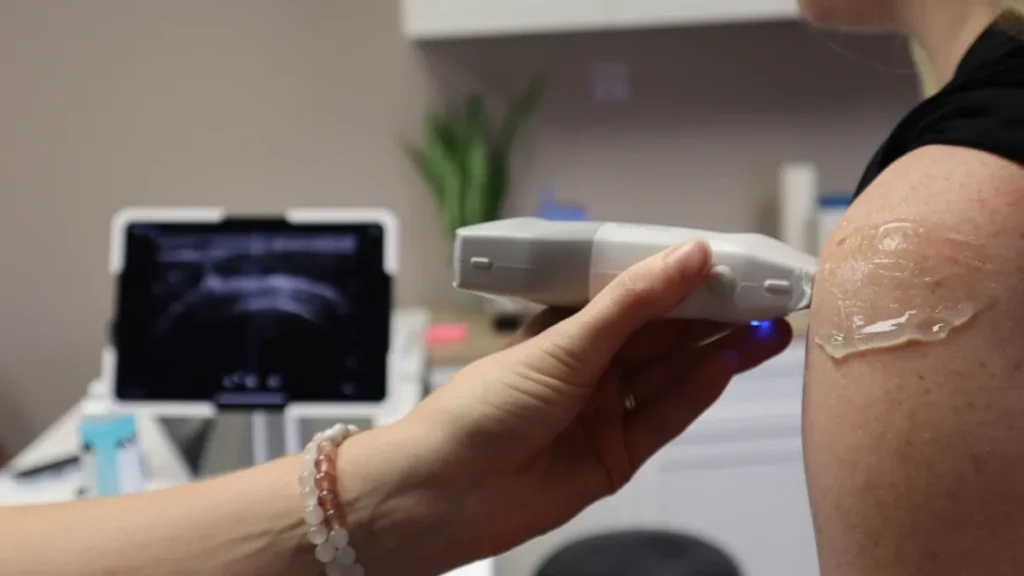
Ultrasound-guided injections hit the target far more often than blind, landmark-guided ones. It was 100% against 72% at the hip, and 86.7% against 26.7% at the biceps tendon sheath. At the subacromial space (under the top of the shoulder) the two were about the same. The record should name the target, the guidance used and what was in the syringe.
Two patients get “a PRP injection” for the same diagnosis, in the same year, in the same city. One improves. One does not, and concludes the treatment does not work.
They did not get the same treatment. They may not even have gotten it in the same part of the body.
How often a blind injection lands somewhere else
An unguided injection is less accurate than most people think. It has been measured.
At the hip, a systematic review and meta-analysis found ultrasound-guided injections accurate in 100% of cases against 72% for landmark-guided ones. At the shoulder, another meta-analysis found accuracy of 93.6% versus 68.2% at the acromioclavicular joint (top of the shoulder). It was 92.5% versus 72.5% at the glenohumeral joint (the main ball-and-socket joint). And here is the number worth sitting with: 86.7% versus 26.7% for the biceps tendon sheath.
The same review is honest about where guidance did not change accuracy. For the subacromial space, guided and unguided shots were about the same. Guidance is not a lucky charm. It matters most where the target is small, deep, or next to something that must not be injected.
Now apply that to a study. Say a trial injects a joint blind and a quarter of the injections miss. Then the trial is not measuring the treatment. It is measuring the treatment watered down by missed shots. And that result then gets quoted back at patients as evidence that biologics do not work.
All orthobiologic care: Our orthobiologics and PRP injections page lists every injury we treat with PRP, bone marrow concentrate and microfragmented fat.
“PRP” is not a description of anything
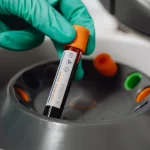
Written on a bill, PRP is roughly as informative as writing “medication.” Bone and joint doctors have known this for years. That is why they published a minimum reporting standard for studies of biologics. It covers platelet dose, leukocyte (white blood cell) content, activation, volume, and how the preparation was made.
Studies follow it poorly. A 2024 systematic review looked at 25 randomized trials in knee osteoarthritis, covering 2,356 patients. On average, the trials reported 53.1% of the checklist items. Not one reached 80%. The worst-reported item was activation, at 14%.
Those details are not paperwork. A meta-analysis of randomized trials found the effect in knee osteoarthritis was influenced by the platelet concentration actually delivered. A meta-analysis of 18 level-1 studies found leukocyte-poor preparations gave better subjective knee scores than leukocyte-rich ones. Two clinics can both say PRP, use very different products, and get very different results.
What goes in the record for every injection here
- The diagnosis, and the test that confirmed it: imaging, nerve testing (electrodiagnostics), or a diagnostic block.
- The exact target in the body, named by structure, not by region.
- The guidance used, ultrasound or fluoroscopy (live X-ray), with images saved.
- The preparation: system used, volume, platelet concentration, leukocyte content, whether activated.
- The published guideline or consensus scenario the reason for treatment matches.
- A validated outcome score before, and at set times after.
- What was done alongside it: loading program, rehab, metabolic care.
Seven lines. They are the difference between a treatment that can be evaluated and a charge that can only be disputed. Why that record is written for a reader you have not met.
When the tendon needs debriding, not filling
Not every damaged structure wants an injection. Tendon tissue that has degenerated (broken down) over time is not inflamed tissue waiting for a signal. It is jumbled tissue taking up space where orderly tissue should be.
Percutaneous hydro-resection [ultrasound-guided removal of degenerated tendon tissue] addresses that directly. A fine saltwater jet, placed under live ultrasound, breaks up and removes diseased tissue. It leaves healthy tendon intact. The opening needs no stitches. It is a structural repair, not a biological signal. Choosing between the two is a diagnostic decision, not a preference.
One rule holds across everything on this page. Match the tool to what the tissue is actually doing. An injection into jumbled tissue and a debridement (cleanout) of an inflamed joint are both precise procedures aimed at the wrong problem.
What to ask before you let anyone inject you
What is the target, and what proved it. Under what imaging. What exactly is in the syringe, in numbers. And what measurement will tell us in three months whether this worked. A clinic that answers those four in a sentence each is working with precision. A clinic that finds the questions odd is telling you something.
Frequently asked questions
Does ultrasound guidance really change an injection result?
It changes accuracy by a wide margin at targets that are hard to hit. Meta-analyses found ultrasound guidance accurate in 100% of hip injections versus 72% landmark-guided. It was 86.7% versus 26.7% for the biceps tendon sheath. They found no accuracy difference at the subacromial space. Learn more: how image-guided procedures fit into a treatment plan.
What should the record say about what was injected?
System used, volume, platelet concentration, leukocyte content, and whether the preparation was activated. Those are the items in the orthopedic minimum reporting standard. A 2024 review found randomized trials reported barely half of those items on average. That is why results vary between clinics using the same word. Learn more: what a defensible treatment record contains.
Is leukocyte-rich or leukocyte-poor PRP better?
For knee osteoarthritis, a meta-analysis of 18 level-1 studies found leukocyte-poor preparations produced better subjective knee scores. The key point for a patient is that the two are different products. The difference should show up in your chart. Learn more: what the knee evidence actually shows.
What is percutaneous hydro-resection?
It is ultrasound-guided removal of degenerated tendon tissue using a fine saline jet. The jet breaks up and removes diseased tissue while leaving healthy tendon intact. It treats a structural problem instead of sending a biological signal. The choice between them is diagnostic. Learn more: how procedures are selected against the diagnosis.
Why do some studies find PRP ineffective?
There are several reasons that are not about the biology. They include the condition studied, the preparation used, the concentration delivered, and whether the needle reached the target. Blind injections miss often enough to water down a result. Trials often do not report the preparation in enough detail to compare. It is also truly negative for some conditions. Learn more: where the evidence is positive and where it is not.
Where is Injury Experts located?
Injury Experts is at 4477 Woodson Rd, Suite 202, St. Louis, MO 63134, next to Lambert International Airport, serving the St. Louis region in Missouri and Illinois. Call (314) 887-5866 or text (314) 886-5902.
Get your injury validated by science, not by an adjuster's spreadsheet
We turn subjective pain into objective, court-ready evidence — biomarkers, biomechanics and diagnostic blocks. Bring us your case before the insurer defines it for you.
Or call or text us.
Sources
- Hoeber S, Aly AR, Ashworth N, Rajasekaran S. Ultrasound-guided hip joint injections are more accurate than landmark-guided injections: a systematic review and meta-analysis. Br J Sports Med. 2016;50(7):392–396. doi:10.1136/bjsports-2014-094570 (PMID 26062955)
- Aly AR, Rajasekaran S, Ashworth N. Ultrasound-guided shoulder girdle injections are more accurate and more effective than landmark-guided injections: a systematic review and meta-analysis. Br J Sports Med. 2015;49(16):1042–1049. doi:10.1136/bjsports-2014-093573 (PMID 25403682)
- Stone AV, Abed V, Owens M, et al. Randomized controlled trials on platelet-rich plasma for knee osteoarthritis poorly adhere to the Minimum Information for Studies Evaluating Biologics in Orthopaedics (MIBO) guidelines: a systematic review. Am J Sports Med. 2024;52(6):1617–1623. doi:10.1177/03635465231185289 (PMID 38282598)
- Belk JW, Kraeutler MJ, Houck DA, et al. Platelet-rich plasma versus hyaluronic acid for knee osteoarthritis: a systematic review and meta-analysis of randomized controlled trials. Am J Sports Med. 2021;49(1):249–260. doi:10.1177/0363546520909397 (PMID 32302218)
- Bensa A, Sangiorgio A, Deabate L, et al. PRP injections for the treatment of knee osteoarthritis: the improvement is clinically significant and influenced by platelet concentration — a meta-analysis of randomized controlled trials. Am J Sports Med. 2025. doi:10.1177/03635465241246524 (PMID 39751394)
- Laver L, Filardo G, Sanchez M, et al. The use of injectable orthobiologics for knee osteoarthritis: a European ESSKA-ORBIT consensus. Part 1 — blood-derived products (platelet-rich plasma). Knee Surg Sports Traumatol Arthrosc. 2024. doi:10.1002/ksa.12077 (PMID 38436492)
- D'Souza RS, Her YF, Hussain N, et al. Evidence-based clinical practice guidelines on regenerative medicine treatment for chronic pain: a consensus report from a multispecialty working group. J Pain Res. 2024. doi:10.2147/JPR.S480559 (PMID 39282657)
This article is for general education and is not medical advice. It does not create a physician–patient relationship. Do not start, stop, or change any medication — including opioid medication — without consulting your physician.
Medically reviewed by Dr. Gurpreet Singh Padda, MD, MBA, MHP — Board Certified in Anesthesiology, Pain Medicine, Interventional Pain Management, Addiction Medicine, and Obesity Medicine.