A soft tissue injury after a car accident is any injury to a part of the body that is not bone. The label covers ligaments, tendons, muscle, cartilage, the meniscus in the knee, the labrum in the hip and shoulder, discs, and nerves. It also covers the brain, the eyes and the liver. It is not a kind of tissue, and it is not a measure of how badly you are hurt.
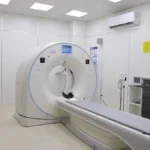
The phrase comes from imaging. On a CT scan, bone shows up bright white because it is dense. Almost everything else shows up in shades of gray. Anything that is not bone gets lumped together as “soft tissue,” and that grouping later turns into the line “it’s just a soft tissue injury.”
What does “soft tissue” include?
Here is a short list of tissues that all count as soft tissue:
- The brain and spinal cord
- The nerve roots that leave the spine and run down an arm or a leg
- Spinal discs
- Ligaments, such as the MCL and ACL in the knee
- The meniscus, the shock absorber inside the knee
- The labrum, the ring of cartilage around the hip and shoulder sockets
- Tendons, such as the rotator cuff
- Muscle
- The eyes, the liver, the spleen and the kidneys
Nobody would call a brain bleed or a torn spleen minor. The same word covers a torn knee ligament, and too often the record treats that word as if it settles the question.
What happened to me after my crash
Early on October 11, 2026, I stopped to pull a woman out of a burning car on the highway, and a driver hit me on the shoulder of the road and kept going. The trauma CT did exactly what it is built to do. It found a broken medial malleolus (the inner ankle bone), a broken fibula and two broken ribs.
The bones turned out to be the simpler problem. By October 26 I was at full activity, standing and walking without restriction. Then, under that daily load, the rest of the damage introduced itself over several weeks:
- A partial compartment syndrome: pressure in the calf that left the gastrocnemius muscle scarred and smaller
- A torn meniscus, left knee
- A torn MCL, same knee
- A torn labrum, left hip
- Left-sided lumbar radiculopathy, with the L4-5 and L5-S1 discs irritating a nerve root that sends symptoms down the leg
- Road rash that is still pushing out fragments of rock debris weeks after the crash. Skin is soft tissue too.
Every one of those is soft tissue, and none of them was on the first scan. The knee and hip tears showed up on ultrasound; the disc and nerve root problem showed up on MRI. We have told patients this for years. It hits differently when the new findings keep turning up in your own leg weeks after you are back to full speed.
Why can a soft tissue injury be worse than a broken bone?
Bone regenerates. A healed fracture is made of bone again, a trick very few tissues can do. A healed fracture is bone again. Most soft tissue does not get that second chance. A torn ligament, meniscus or labrum, or a muscle that lost its blood supply, heals with scar tissue, and scar tissue is weaker and stiffer than what it replaced. Some of these tissues barely heal at all, because they have a poor blood supply to begin with.
That changes how a joint moves. A knee with a torn MCL and a damaged meniscus takes load unevenly. The cartilage under the uneven load wears faster. A hip with a torn labrum loses part of its seal and its shock absorption. A nerve root that is irritated keeps firing long after the bruise around it is gone. The fracture gets a cast and an expected healing date. The soft tissue often gets a label instead, and the pain and disability that follow can far outlast the bone.
How often does a broken bone come with a hidden soft tissue injury?
More often than the first X-ray or CT suggests. Two examples from the research:
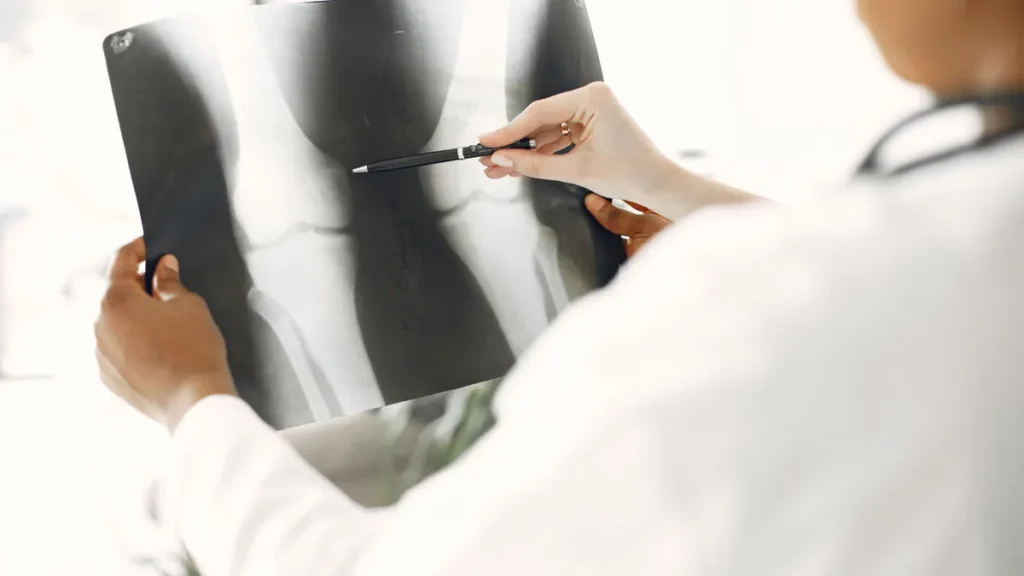
- Researchers put 59 surgical ankle fractures through MRI as well as X-ray. Over 65% turned out to have a ligament torn all the way through, sitting next to the broken malleolus. The standard way of reading the X-ray to predict ligament damage missed the actual pattern in 53% of the fractures it could classify.1
- In 42 knees above a broken shin bone, 41 showed at least one injury on MRI, and 35 had a ligament injury. Most of those healed without trouble by the time the fracture healed.2 The point is not that every one needs treatment. The point is that nobody sees them unless someone looks.
Across trauma studies, the rate of missed or delayed diagnoses ranges from 1.3% to 39% of patients, depending on how a study defines a miss.3 We explain what the ER scan is designed to find, and what it is not, in why the ER CT scan can miss an injury.
Why do soft tissue injuries show up later?
Because the body is built to hide pain during an emergency, and because many soft tissue injuries only hurt once you load them. A torn meniscus can be quiet while the leg is in a boot. It speaks up the first week you walk on it. That timing is expected, not suspicious. The science behind it, including the gate control theory of pain, is in why pain shows up days or weeks after a crash.
What should you do if you were told it is “just soft tissue”?
- Ask which tissue. A muscle strain, a torn ligament and a pinched nerve are different injuries with different treatments.
- Write down new symptoms and the date each one started. Buckling knees, catching hips and numbness that travels down a leg all count as new information.
- Get examined when something new appears. An exam decides whether an MRI, an ultrasound or a nerve test is the right next step.
- Keep moving within what the injury allows. Scar tissue forms along the lines it is loaded. Our physician-directed physiotherapy program is built around that.
Neck injuries get their own discussion in “soft tissue” injury, but my neck is killing me. Attorneys and case managers will find the record-building side in delayed symptoms and the gap-in-treatment argument.
Frequently asked questions
Is a soft tissue injury serious?
It can be. Soft tissue includes ligaments, the meniscus, the hip labrum, discs and nerves, as well as the brain. A torn ligament or a pinched nerve root can cause more lasting pain and disability than a fracture, because bone heals back to bone and most soft tissue heals with scar.
Does a CT scan show soft tissue damage?
Not well. On CT, a torn ligament or labrum can blend into the gray around it, while bone and fresh blood stand out. MRI, ultrasound and nerve studies are built for those structures, and an exam decides which test fits.
How long does a soft tissue injury take to show up?
Some show up within hours. Others take days or weeks, especially injuries that only hurt under load, such as a meniscus or labral tear. In my own case, several soft tissue injuries surfaced over weeks, after the fractures had healed.
Where is Injury Experts located?
We are at 4477 Woodson Rd, Suite 202, St. Louis, MO 63134, next to Lambert International Airport. Call (314) 887-5866, text (314) 886-5902, or schedule online.
Told it’s “just soft tissue”?
If a knee gives way, a hip catches, or pain runs down a leg after a crash, that is new information. A physician exam finds which tissue is hurt and orders the right test.
Or call or text us.
Sources
- Gardner MJ, Demetrakopoulos D, Briggs SM, Helfet DL, Lorich DG. The ability of the Lauge-Hansen classification to predict ligament injury and mechanism in ankle fractures: an MRI study. Journal of Orthopaedic Trauma. 2006;20(4):267-72. doi:10.1097/00005131-200604000-00006 (PMID 16721242)
- Guler F, Kose O, Erol B, Turan A, Koroglu M, Akalin S. The prevalence of knee injuries ipsilateral to tibial shaft fractures and their impact on clinical outcome. European Journal of Orthopaedic Surgery & Traumatology. 2015;25(1):141-8. doi:10.1007/s00590-014-1465-5 (PMID 24760481)
- Pfeifer R, Pape HC. Missed injuries in trauma patients: A literature review. Patient Safety in Surgery. 2008;2:20. doi:10.1186/1754-9493-2-20 (PMID 18721480)
Written and medically reviewed by Dr. Gurpreet Singh Padda, MD, MBA, MHP — Board Certified in Anesthesiology, Pain Medicine, Interventional Pain Management, Addiction Medicine, and Obesity Medicine. Last reviewed November 5, 2026.