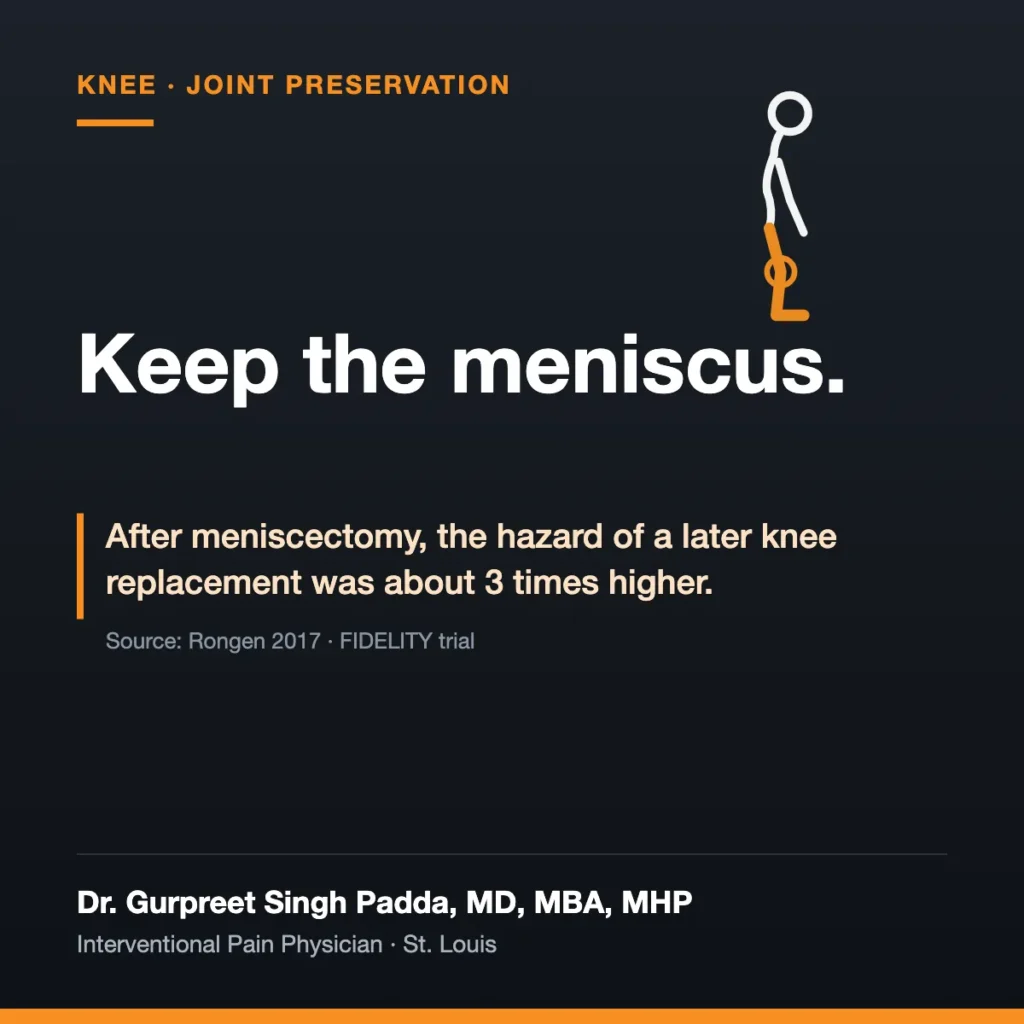
If a car accident tears the meniscus in your knee, the goal is to keep that tissue, not cut it out. Removing part of the meniscus ranks among the most frequent knee operations in the US, and in a large US study the people who had it were about three times as likely to need a knee replacement later. At Injury Experts, a physician treats the injured knee with orthobiologic injections, guided strength work and care for the whole body, so the meniscus you have stays in place.
Most people hear “torn meniscus” and assume surgery is the next step. For many knees, it is the step that causes the most trouble down the road.
What does the meniscus do in your knee?
Each knee has two meniscus pads, C-shaped pieces of rubbery cartilage that sit between the thigh bone and the shin bone. They spread your body weight across the joint and soak up the jolt of every step, stair and squat.
When a surgeon trims away a torn piece, the weight no longer spreads as well. The same load now presses on a smaller patch of joint cartilage, and that patch wears faster. A crash can tear the meniscus in an instant. Losing it to an operation is a second injury to the same joint.
Does meniscus surgery raise the risk of a knee replacement?
The best long-term data say yes. The Osteoarthritis Initiative followed adults aged 45 to 79 who had knee arthritis or a high risk of it. Of 335 people who had an arthroscopic meniscectomy, 63 (18.8%) later had a knee replacement in the same knee. Among 335 closely matched people who did not have the surgery, 38 (11.1%) did. The hazard of a replacement was 3.03 times higher after the meniscus surgery.1
That study looked at people who already had worn knees or were likely to develop them. Many people hurt in a crash are in that age range, and their knees were not new on the day of the accident.
Does removing a torn meniscus help the pain?
The FIDELITY trial in Finland tested that question directly. It enrolled 146 adults aged 35 to 65 with knee symptoms from a worn, degenerative tear of the inner meniscus. Half got a partial meniscectomy. The other half got a sham operation, a look inside the knee with nothing removed. Neither the patients nor the people scoring their outcomes knew who got which. At one year, the two groups had improved by about the same amount.2
The same patients were checked again at five years:
- X-rays showed slightly more arthritis progression in the knees that had the meniscus trimmed.3
- Catching and locking were more common after the real operation, with an adjusted difference of 18 percentage points.3
- On MRI, bone spurs grew more often after the real operation. The odds were 2.86 times higher.4
So the surgery did not beat a fake operation for pain, and it left the joint in somewhat worse shape five years out.
How do we treat a torn meniscus without surgery?
We start by examining the knee and confirming what is torn and how the joint moves. Then we build a plan that protects the tissue:
- Orthobiologic injections. In a review of 48 trials and 9,338 arthritic knees, platelet-rich plasma (PRP), bone marrow aspirate concentrate (BMAC) and hyaluronic acid all outperformed steroid shots on pain and function at six months or longer.5 Our orthobiologics page explains each option.
- Strength work. Muscles around the knee carry load the joint would otherwise absorb. Our physician-directed physiotherapy program loads the knee the way it is built to be loaded and adds weight as it improves.
- The rest of the body. Insulin resistance, extra weight and months on the couch after a crash all speed up cartilage loss. We treat those along with the knee, because the knee does not heal apart from the rest of you.
Can PRP regrow a torn meniscus?
No, and we do not tell patients it can. The European knee society’s 2019 consensus on meniscus tears from injury found no evidence that PRP improves meniscus healing.6 The same consensus called saving the meniscus the first line of treatment, because long-term results after partial removal are worse than after repair.6
PRP is about the joint around the tear: pain, function and slowing the wear. The aim is a working knee that still has its own cushion.
When does a torn meniscus need a surgeon?
A knee that truly locks and will not straighten, or a fresh tear that a surgeon can stitch back together, is a different problem. Repair keeps the tissue, so that patient goes to a surgeon. Our exam sorts out which knee is which before any decision is made.
What should attorneys know about a meniscus tear after a crash?
If a crash-injured knee is scoped and part of the meniscus is removed, the future-care picture should include a possible knee replacement years later. The record should show how the tear was found, what treatment was tried first, and how the knee functions at each visit. Our page for attorneys covers records requests and how to refer a client.
Frequently asked questions
Can a torn meniscus heal without surgery?
Many meniscus tears settle with treatment that does not remove tissue. Strength work, injections and care for the whole body aim to calm pain and keep the knee working. A tear that locks the knee or can be stitched needs a surgeon’s opinion.
Is a partial meniscectomy better than physical therapy?
For worn, degenerative tears, a sham-controlled trial found the operation did no better than a fake procedure at one year. At five years, the operated knees had a little more arthritis on X-ray and more catching or locking.
Does PRP fix a torn meniscus?
No. PRP does not regrow meniscus tissue, and a European expert consensus found no evidence that it improves meniscus healing. We use it for knee pain and function while the meniscus stays in place.
Where is Injury Experts located?
We are at 4477 Woodson Rd, Suite 202, St. Louis, MO 63134, next to Lambert International Airport. Call (314) 887-5866, text (314) 886-5902, or schedule online.
Knee still hurting after the crash?
A torn meniscus deserves a physician exam before anyone talks about cutting it out. We check the knee, explain what is torn, and build a plan that keeps the tissue you have.
Or call or text us.
Sources
- Rongen JJ, Rovers MM, van Tienen TG, Buma P, Hannink G. Increased risk for knee replacement surgery after arthroscopic surgery for degenerative meniscal tears: a multi-center longitudinal observational study using data from the osteoarthritis initiative. Osteoarthritis and Cartilage. 2017;25(1):23-29. doi:10.1016/j.joca.2016.09.013 (PMID 27712957)
- Sihvonen R, Paavola M, Malmivaara A, Itälä A, Joukainen A, Nurmi H, et al. Arthroscopic partial meniscectomy versus sham surgery for a degenerative meniscal tear. New England Journal of Medicine. 2013;369(26):2515-24. doi:10.1056/NEJMoa1305189 (PMID 24369076)
- Sihvonen R, Paavola M, Malmivaara A, Itälä A, Joukainen A, Kalske J, et al. Arthroscopic partial meniscectomy for a degenerative meniscus tear: a 5 year follow-up of the placebo-surgery controlled FIDELITY (Finnish Degenerative Meniscus Lesion Study) trial. British Journal of Sports Medicine. 2020;54(22):1332-1339. doi:10.1136/bjsports-2020-102813 (PMID 32855201)
- Sillanpää N, Iivanainen M, Turkiewicz A, Sihvonen R, Paavola M, Taimela S, et al. Effect of arthroscopic partial meniscectomy on structural degeneration of the knee – A 5-year MRI-based follow-up of the placebo-surgery controlled FIDELITY (Finnish Degenerative Meniscus Lesion Study) trial. Osteoarthritis and Cartilage. 2025;33(2):276-282. doi:10.1016/j.joca.2024.09.003 (PMID 39277028)
- Jawanda H, Khan ZA, Warrier AA, Acuña AJ, Allahabadi S, Kaplan DJ, et al. Platelet-Rich Plasma, Bone Marrow Aspirate Concentrate, and Hyaluronic Acid Injections Outperform Corticosteroids in Pain and Function Scores at a Minimum of 6 Months as Intra-Articular Injections for Knee Osteoarthritis: A Systematic Review and Network Meta-analysis. Arthroscopy. 2024;40(5):1623-1636.e1. doi:10.1016/j.arthro.2024.01.037 (PMID 38331363)
- Kopf S, Beaufils P, Hirschmann MT, Rotigliano N, Ollivier M, Pereira H, et al. Management of traumatic meniscus tears: the 2019 ESSKA meniscus consensus. Knee Surgery, Sports Traumatology, Arthroscopy. 2020;28(4):1177-1194. doi:10.1007/s00167-020-05847-3 (PMID 32052121)
Written and medically reviewed by Dr. Gurpreet Singh Padda, MD, MBA, MHP — Board Certified in Anesthesiology, Pain Medicine, Interventional Pain Management, Addiction Medicine, and Obesity Medicine. Last reviewed November 10, 2026.