
If you are living with a serious injury, the number occupying your attention is almost certainly the next medical bill. That is the number the system wants you focused on, because it is small, immediate, and settleable.
The number that will actually determine the shape of your life is much further out, and nobody sends you an invoice for it.
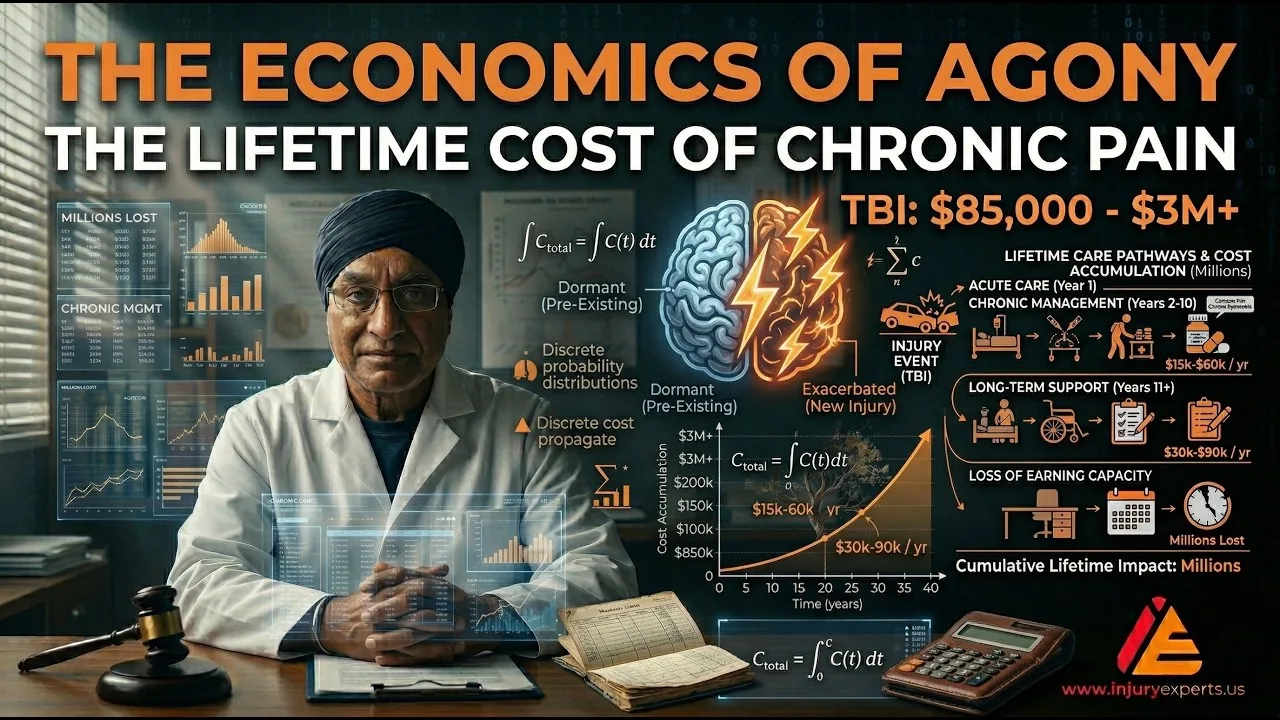
Watch on YouTube: The Economics of Agony: The Lifetime Cost of Chronic Pain
Why a brain injury does not have a fixed price
An injury is not a static event that concludes when the tissue closes. A traumatic brain injury sets off a metabolic crisis in which the energy supply available to neural tissue cannot meet the demands of repair. That mismatch does not resolve on the schedule of a claim.
The cost range reflects this. The figures cited in the video are approximately $85,000 as a starting point for a mild TBI, escalating past $3 million for a significant one.
Be careful with this range. We went looking for its origin. The $85,000-to-$3-million span is repeated across a great many legal and advocacy websites, but we could not trace it to a peer-reviewed primary source. It is best treated as a widely circulated illustration of scale, not as a research-grade valuation — and it should never be presented to a court without a defensible source behind it. In a specific case, the number that matters is a life care plan built on that person’s actual projected needs.
The gap between those numbers is not mostly about surgery. It is about decades of care, lost earnings, and secondary consequences that accumulate.
The long-term neurological risk
Traumatic brain injury is an established risk factor for later neurodegenerative disease, including Alzheimer’s disease and Parkinson’s disease. This association is well documented in the epidemiological literature.
Two cautions matter, and they cut against overstatement. Risk is not destiny — most people who sustain a TBI will not develop these conditions, and the size of the increase varies substantially with injury severity, frequency and the population studied. The mechanisms remain an area of active research rather than settled science. Any presentation of a head injury as a guaranteed path to dementia is not supported by the evidence and should be treated with suspicion, including in a courtroom.
Chronic pain as a thief of time value
In finance, a dollar today is worth more than a dollar tomorrow. For someone living with a disabling injury, that logic inverts in a punishing way.
Diminished earning capacity is not simply this year’s missed salary. It is the promotion not received, the contributions not made, the compounding that does not happen — and, ultimately, the wealth that does not pass to the next generation. Settling against today’s bills converts a multi-decade loss into a single payment calculated on the wrong horizon.
This is measurable. Malhotra and colleagues (JAMA Surgery, 2024) linked hospitalization and taxation records for 18,050 patients and tracked employment and personal income for three years after traumatic brain injury. Income and employment losses were significant and persisted into years two and three — and the authors noted that the losses following mild injuries, which made up most of the cohort, were larger than expected.
Two honest qualifications: it is a Canadian study, so the labor market and income figures do not transfer directly to a US claim, and three years is the study window rather than the duration of the problem.
How you are actually valued
Injury claims are substantially scored by software. Black-box algorithms — most commonly Colossus — reduce a person to a set of codes. The vendor’s own sales literature, documented by the Consumer Federation of America, boasted that it would “immediately reduce the size of bodily injury claims by up to 20 percent” — largely by discounting subjective reports of pain.
Sourced: Consumer Federation of America, Low Ball: An Insider’s Look at How Some Insurers Can Manipulate Computerized Systems (2012). CFA also documented that Allstate’s payout per premium dollar in auto injury cases fell from about 63 cents to 47 cents over a decade. This is the vendor’s and insurer’s own record — not a plaintiff-side estimate.
The mechanism to understand is that these systems punish thin documentation. They also rely on time: delay is a lever, and a claimant whose savings are exhausted becomes far more willing to accept a low offer.
Three ways to answer with data
1 · Metabolic analysis. Document the biological terrain. Elevated systemic inflammation — TNF-α, IL-6, high-sensitivity CRP — describes a physiologically more severe injury and a slower expected recovery, in a form that does not depend on self-report. The mechanism
2 · Diagnostic blocks. A targeted anesthetic block that reliably abolishes a specific pain is a physiological demonstration that the pain circuit exists and can be localized — objective evidence rather than testimony. Why this survives scrutiny
3 · Life care planning. The future is calculated rather than guessed: the projected course of care, accounting for secondary complications from neuroinflammation through metabolic decline, expressed as a defensible schedule of need rather than an assertion that things will probably be bad.
Frequently asked questions
What does a traumatic brain injury cost over a lifetime?
Published estimates range enormously with severity — from roughly $85,000 for mild injury to several million dollars for severe injury. These estimates vary by methodology and study year, so any figure used in a specific case should be sourced and defended rather than quoted generically.
That is the subject of The Injury You Can Photograph Is the Smaller Half.
Should I settle my injury claim now?
That is a decision for you and your attorney. Understand that a settlement typically resolves future claims too. If your condition has not stabilized, the future portion is being estimated rather than observed — which is precisely the uncertainty an insurer is better resourced to price than you are.
That is the subject of The Injury You Can Photograph Is the Smaller Half.
Does a brain injury cause Alzheimer’s or Parkinson’s?
TBI is an established risk factor for later neurodegenerative disease, but it is not a cause in the deterministic sense. Most people who sustain a TBI do not go on to develop these conditions, and risk varies with severity and repetition.
The Fear Every Honest Patient Carries goes through it in detail.
What is a life care plan?
A structured projection of the medical care, equipment, therapy and support a person is expected to need over their lifetime as a result of an injury, with associated costs. It converts “he will need ongoing care” into an itemized, examinable schedule.
See Your Claim Is Not Being Evaluated. It Is Being Scored..
Why do insurers delay?
Delay is inexpensive for a large organization and costly for an individual. As personal finances deteriorate, willingness to accept a lower settlement rises. The physiological cost of that pressure is described in the secondary effects of injury.
Where is Injury Experts located?
Injury Experts is at 4477 Woodson Rd, Suite 202, St. Louis, MO 63134, next to Lambert International Airport, serving the St. Louis region in Missouri and Illinois. Call (314) 887-5866 or text (314) 886-5902.
This is set out in The “Independent” Medical Examination Is Not Independent.
Get your injury validated by science, not by an adjuster's spreadsheet
We turn subjective pain into objective, court-ready evidence — biomarkers, biomechanics and diagnostic blocks. Bring us your case before the insurer defines it for you.
Or call (314) 887-5866 · text (314) 886-5902
Key takeaways
- A brain injury is a decades-long metabolic event, not a closed episode of care.
- Published lifetime costs span roughly $85,000 to several million by severity — ranges, not fixed valuations.
- TBI raises the risk of neurodegenerative disease; it does not guarantee it.
- Diminished earning capacity compounds and reaches the next generation.
- Metabolic markers, diagnostic blocks and a life care plan answer an algorithm with data.
Medically reviewed by Gurpreet Singh Padda, MD, MBA, MHP — Board Certified in Anesthesiology, Pain Medicine, Interventional Pain Management, Addiction Medicine, and Obesity Medicine.
This article is for general education and is not medical, legal, or financial advice. It does not create a physician–patient or attorney–client relationship. Decisions about settling a claim should be made with your attorney.