
Most of the medical attention after a serious injury goes to the thing that shows up on film — the fracture, the herniated disc, the visible damage. That is reasonable. It is also incomplete, and the incompleteness is expensive.
A physical injury is rarely a single event. It is a pivot point, and what follows it is a cascade: sleep that does not restore, a mood that will not settle, work that becomes impossible, a marriage under strain, savings draining toward medical bills. These are routinely dismissed as soft, subjective, or someone else’s specialty. They are none of those things. They are measurable, they are biological, and they change how fast you heal.
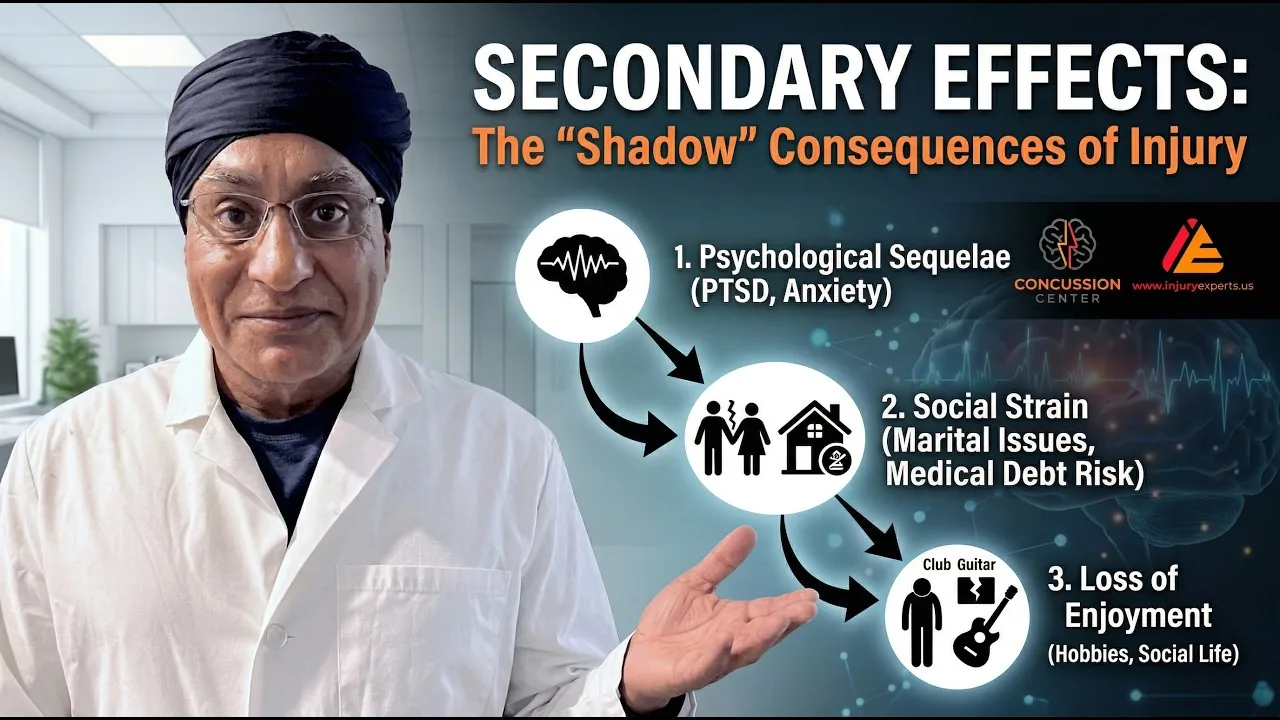
Watch on YouTube: Secondary Effects: The Shadow Consequences of Injury
PTSD after a collision is not a willpower problem
If you are anxious, hypervigilant, or unable to get back in a car without your chest tightening, you have not failed at coping.
Traumatic stress triggers a systemic release of pro-inflammatory cytokines — the same class of molecules released by the physical injury itself. They behave like chemical gasoline: lowering the pain threshold, sensitizing the nervous system, and keeping the whole system on alert.
This is why the insurance framing — physical injury over here, mental health over there, please file them separately — is biologically incoherent. A distressed mind and an injured body are being fed by the same inflammatory fire. Separating them is an accounting convenience, not a clinical fact.
Functional neurological disorder is not faking
One of the most common fears after an injury is being labeled a malingerer. It is worth being precise: functional neurological disorder is not feigning and it is not malingering. It is a genuine disorder of nervous system function, now recognized as such, and it is diagnosed on positive clinical signs rather than by excluding everything else.
Where symptoms are questioned, objective physical findings answer the question. A diagnostic block — a targeted anesthetic that reliably abolishes a specific pain and lets it return as the block wears off — demonstrates that the pain circuit exists and where it runs. How that becomes evidence
Debt is a physiological event
Medical debt is normally filed under finance. Physiologically, it belongs under stressors.
Sustained financial desperation drives a high-cortisol state, and high cortisol is catabolic — it favors tissue breakdown over repair. A body under continuous economic threat is being instructed, hormonally, not to rebuild.
This has an uncomfortable implication. Delay is not neutral in a claim. When the process is drawn out while bills accumulate, the resulting physiological state works against the very recovery being disputed. The strategy of waiting for a claimant’s resources to run down before making an offer has a biological cost, not only a financial one.
Isolation is a clinical finding
When an injury stops you attending your church, your job, your friendships, the loss registers as more than sadness. Holt-Lunstad and colleagues (Perspectives on Psychological Science, 2015) pooled the literature and found social isolation associated with a 29% increase in mortality risk, loneliness 26%, and living alone 32% — risk the authors concluded exceeds that from obesity.
“Loss of enjoyment of life” is treated by the assembly line as too subjective to count. We treat it as data, because the mechanism is real: withdrawal from social and physical activity degrades sleep, movement and metabolic health, all of which feed back into pain.
The same holds for relationships. Marital and family strain following injury is associated with substantially worse work outcomes — the video cites productivity loss being roughly two-thirds more likely where such strain exists. That specific figure requires citation confirmation before it should be relied on.
What the labor-market data shows
The economic consequences of a significant injury extend well beyond active treatment. Malhotra and colleagues (JAMA Surgery, 2024) linked hospitalization and taxation records for 18,050 patients and followed employment and income for three years after traumatic brain injury. Losses were significant and persisted into years two and three, and — notably — were substantial even after mild injuries, which made up most of the cohort.
This is a Canadian study, so the dollar figures do not transfer to a US claim. The pattern does: settling against this year’s medical bills ignores the compounding value of work you may not return to.
What we do about it
The premise is that the biological soil determines whether anything planted in it survives. An injection into a toxic terrain is a temporary bandage — a point that holds whether or not the injection was technically well performed.
So the work runs in parallel: document the terrain, and repair it. Sleep, movement and nervous system regulation are treated as clinical targets rather than lifestyle advice, alongside the metabolic and inflammatory markers that describe how much capacity for healing you currently have. More on the metabolic side
Frequently asked questions
Are psychological effects part of an injury claim?
They are frequently part of a claim, and they are medically inseparable from the physical injury: traumatic stress and tissue trauma drive overlapping inflammatory responses. Whether and how they are compensable in your case is a legal question for your attorney.
There is more on this in You Did Everything Right and the Pain Stayed. That Is Information..
Is functional neurological disorder the same as malingering?
No. Malingering means deliberately feigning symptoms for gain. Functional neurological disorder is a genuine disorder of how the nervous system functions, diagnosed on positive clinical signs. Conflating the two is a clinical error.
The detail is in You Are Looking at the Wrong Number.
Can financial stress really slow physical healing?
The mechanism is well described: chronic stress sustains elevated cortisol, and high-cortisol states are catabolic, favoring tissue breakdown over repair. Debt and financial insecurity act as chronic stressors in exactly this way.
The detail is in You Did Everything Right and the Pain Stayed. That Is Information..
How do I document loss of enjoyment of life?
Specifically and contemporaneously. Record the activities you have stopped, when you stopped them, and how often you used to do them — work, worship, sport, caregiving, social contact. Dated specifics are far harder to discount than a general statement that life is worse.
See You Are Looking at the Wrong Number.
Should I settle while I am still symptomatic?
That is a decision for you and your attorney, but understand what is being traded: a settlement resolves future claims as well as present bills. If symptoms are unresolved, the future cost is being estimated, not observed.
There is more on this in You Are Looking at the Wrong Number.
Where is Injury Experts located?
Injury Experts is at 4477 Woodson Rd, Suite 202, St. Louis, MO 63134, next to Lambert International Airport, serving the St. Louis region in Missouri and Illinois. Call (314) 887-5866 or text (314) 886-5902.
The mechanism is covered in You Did Everything Right and the Pain Stayed. That Is Information..
Get your injury validated by science, not by an adjuster's spreadsheet
We turn subjective pain into objective, court-ready evidence — biomarkers, biomechanics and diagnostic blocks. Bring us your case before the insurer defines it for you.
Or call (314) 887-5866 · text (314) 886-5902
Key takeaways
- Post-injury PTSD and anxiety share an inflammatory mechanism with the physical injury; siloing them is not clinically coherent.
- Functional neurological disorder is a real diagnosis, not feigning.
- Financial stress and isolation are physiological stressors that impair repair.
- Loss of enjoyment of life can be documented as dated, specific functional loss.
- Repairing the biological terrain determines whether any local treatment holds.
Medically reviewed by Gurpreet Singh Padda, MD, MBA, MHP — Board Certified in Anesthesiology, Pain Medicine, Interventional Pain Management, Addiction Medicine, and Obesity Medicine.
This article is for general education and is not medical or legal advice. It does not create a physician–patient or attorney–client relationship. Do not start, stop, or change any medication without consulting your physician. If you are experiencing thoughts of self-harm, contact the 988 Suicide and Crisis Lifeline by calling or texting 988.