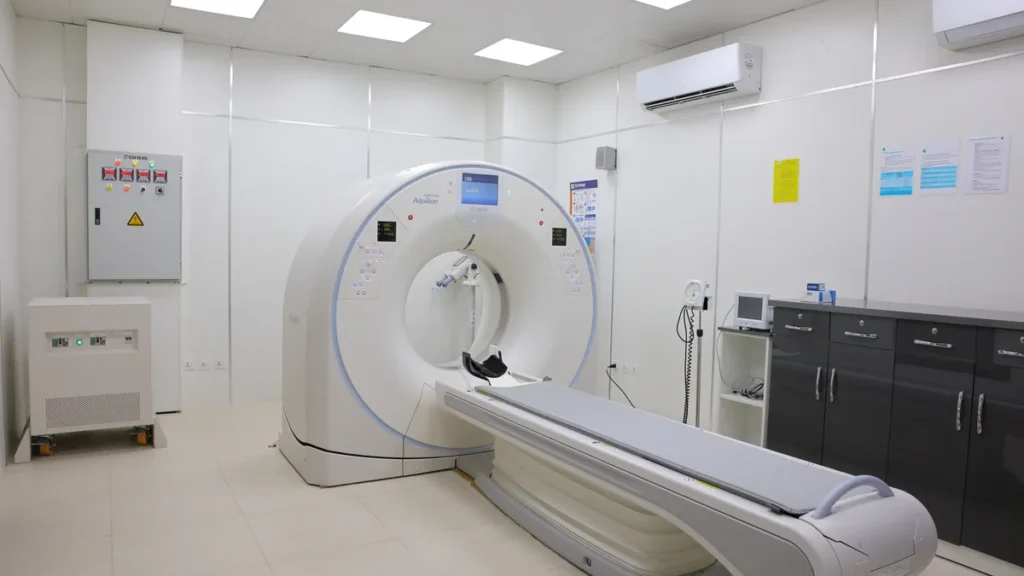
An ER CT scan can miss an injury after a car accident because it is built to answer one question fast: is anything about to kill you? It is excellent at finding bleeding, a shifted brain, a broken spine and broken bones. It is much weaker at ligaments, cartilage, the meniscus, the hip labrum and nerve roots. A clear CT rules out an emergency. It does not rule out an injury.
That is not a complaint about emergency medicine. The ER is doing the right job on the right day. The trouble starts when “the CT was normal” gets read later as “nothing was hurt.”
What is a trauma CT looking for?
When a crash patient arrives, the trauma team works through a set order. Airway, breathing, circulation, the brain, the spine. Then a head-to-toe check for other injuries. The CT scanner fits that order perfectly. In a few minutes it shows blood where blood shouldn’t be, air where air shouldn’t be, and bone that is broken or out of place.
Notice what is on that list. Every item is something that needs a surgeon or an intervention in the next hours. A torn knee ligament is not on it, and it shouldn’t be. Nobody should delay a scan of a bleeding abdomen to examine a knee.
What does CT see poorly?
CT builds its picture from how much X-ray each tissue blocks. Bone blocks a lot. Most other tissues block similar amounts and blur into neighboring grays. A ligament, a tendon and the muscle beside it can look nearly the same.
The numbers make this concrete. A German group checked 204 freshly injured knees by CT first and by MRI or arthroscopy afterward. Even with musculoskeletal radiologists reading them, conventional CT got the ACL, the knee’s main stabilizing ligament, right 75% of the time. A newer dual-energy CT technique did better, at 94%.1 Even when specialists are looking for the ligament on purpose, the standard scan misses a meaningful share. In a busy trauma bay, nobody is looking for it on purpose.
How often are injuries found late?
Pulling together the trauma literature, one review put missed or late diagnoses anywhere from 1.3% to 39% of patients. Among patients with a miss, 15% to 22.3% had one that mattered clinically.2 The wide range reflects how differently studies define a miss. It also reflects who gets missed. In one Level I trauma center, the patients with missed injuries had higher injury severity scores, and 60% of them had a brain injury.3 The sicker the patient, the more the team has to triage, and the more a quiet injury waits.
Ligaments around a fracture are a classic example. A Korean review of 448 knee-region fractures counted 35 with a torn posterior cruciate ligament (PCL) hiding beside the break. In 22 of those 35, the PCL tear was found late, in the clinic after the fracture had been treated.4 The fracture was the loud injury. The ligament waited its turn.
Do trauma centers know the first look misses things?
Yes, and that is the most telling part. Trauma centers build in a “tertiary survey”: once the patient is stable, usually within a day, a clinician repeats the full exam from scalp to toes. One trauma center that made it routine cut its missed-injury rate by 36%.3 A meta-analysis of seven studies covering 12,581 trauma patients found that this repeat exam caught more injuries and let fewer slip through.5
The profession built a second check because the first one misses things. A patient whose torn ligament turns up in week three is not a patient who invented an injury. They are the expected case the tertiary survey was designed for. A tertiary survey happens in the hospital, though. Many crash patients are discharged from the ER the same night, and their second look has to happen in a clinic.
Which tests find what the CT missed?
- A physician exam. Ligament stress tests, joint stability, the pattern of numbness or weakness. The exam decides what to image.
- MRI for ligaments, the meniscus, the labrum, discs, nerve roots and muscle.
- Ultrasound for tendons and some ligaments, and to watch structures move.
- Nerve studies (EMG) when the question is whether a nerve or nerve root is damaged. See our pages on the EMG of the leg and the EMG of the arm.
Brain injury has its own version of this problem. A normal head CT does not rule out a concussion, as we explain in your CT scan is clear and your head still isn’t.
The label that usually lands on these late findings, “just soft tissue,” is taken apart in what a soft tissue injury actually means.
The timing question gets its own page: why pain from these tissues often starts days or weeks after the crash. So does the paperwork, in how a late finding is tied back to the accident in the record.
Frequently asked questions
Can a CT scan miss a torn ligament?
Yes. CT is built to show bone and bleeding. When freshly injured knees were checked against MRI or arthroscopy, conventional CT read the ACL correctly 75% of the time. MRI and a physician exam are the usual ways to find a torn ligament.
My ER scan was normal. Why do I still hurt?
Because a normal trauma CT means no bleeding, no fracture and no emergency. Ligaments, cartilage, the meniscus, the hip labrum and nerve roots can be injured and still look normal on that scan.
Should I go back to the ER if new pain shows up weeks later?
Go back to the ER or call 911 for an emergency: new weakness, loss of bladder or bowel control, a cold or pale limb, chest pain or trouble breathing, or a worsening headache. For an unstable knee, a catching hip or a new nerve pattern in a leg, book a physician exam so the right test gets ordered.
Where is Injury Experts located?
We are at 4477 Woodson Rd, Suite 202, St. Louis, MO 63134, next to Lambert International Airport. Call (314) 887-5866, text (314) 886-5902, or schedule online.
Your scan was clear. You’re not.
A normal ER CT ruled out the emergency. If you still hurt, or something new started after the crash, we examine it and pick the scan or study built for that tissue.
Or call or text us.
Sources
- Gruenewald LD, Booz C, Martin SS, Mahmoudi S, Yel I, Eichler K, et al. Diagnostic performance of modern computed tomography in cruciate ligament injury detection: A comprehensive study. European Journal of Radiology. 2024;170:111235. doi:10.1016/j.ejrad.2023.111235 (PMID 38071908)
- Pfeifer R, Pape HC. Missed injuries in trauma patients: A literature review. Patient Safety in Surgery. 2008;2:20. doi:10.1186/1754-9493-2-20 (PMID 18721480)
- Biffl WL, Harrington DT, Cioffi WG. Implementation of a tertiary trauma survey decreases missed injuries. The Journal of Trauma. 2003;54(1):38-43; discussion 43-4. doi:10.1097/00005373-200301000-00005 (PMID 12544897)
- Kim JG, Lim HC, Kim HJ, Hwang MH, Yoon YC, Oh JK. Delayed detection of clinically significant posterior cruciate ligament injury after peri-articular fracture around the knee of 448 patients. Archives of Orthopaedic and Trauma Surgery. 2012;132(12):1741-6. doi:10.1007/s00402-012-1605-5 (PMID 22926737)
- Hajibandeh S, Hajibandeh S, Idehen N. Meta-analysis of the effect of tertiary survey on missed injury rate in trauma patients. Injury. 2015;46(12):2474-82. doi:10.1016/j.injury.2015.09.019 (PMID 26517956)
Written and medically reviewed by Dr. Gurpreet Singh Padda, MD, MBA, MHP — Board Certified in Anesthesiology, Pain Medicine, Interventional Pain Management, Addiction Medicine, and Obesity Medicine. Last reviewed November 5, 2026.