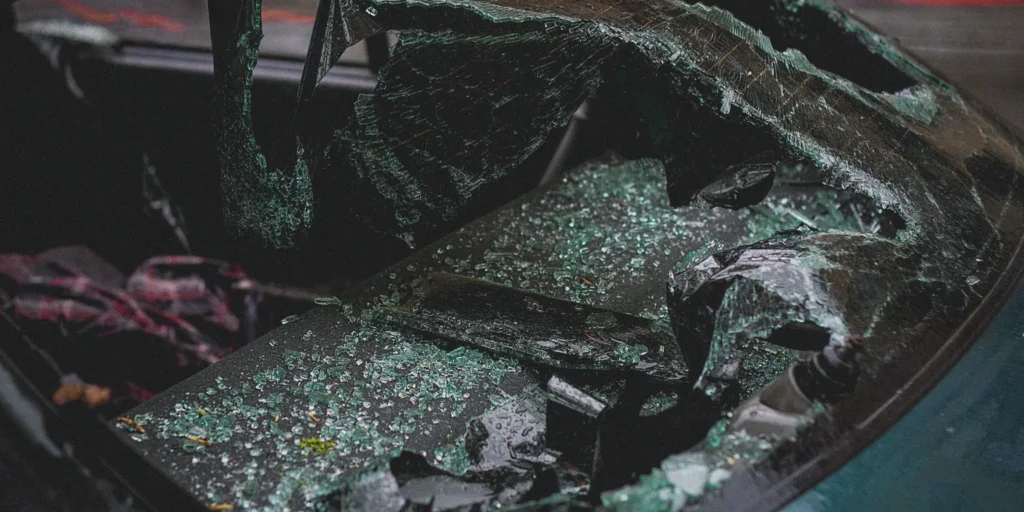
A car crash injures the body in two ways. One is blunt impact, when you strike something. The other is inertial loading, when your own body mass does the damage. That is how most neck injuries happen. No injury threshold applies to everyone. So two people in the same crash can walk away with very different injuries.
In 2023 there were an estimated 6,138,359 police-reported traffic crashes in the United States. They killed 40,901 people and injured an estimated 2,442,581 more. That is about five people hurt every minute, all year. The dead get counted carefully. The two and a half million hurt get counted once. Then people argue about them for the next two years.
This page is about what really happens to a body in those few tenths of a second. It is also about what the weeks after decide.
There is no universal injury threshold, and that is the whole argument
The most useful finding in crash-injury research is a negative one. No single injury limit applies to everyone in a vehicle. Whether a crash hurts a person depends on three separate stacks of factors. First is who the person is: age, height, weight, sex, bone density, and any medical, bone or muscle problems they brought with them. Second is what was true in the seconds before impact: whether they saw it coming, how they sat, where the seatbelt and head restraint were, and what the vehicle was. Third is the crash itself: its direction, how the vehicle moved, the safety systems that fired, and how the person’s body moved in response.
Two people in the same car, in the same crash, can walk away with very different injuries. That is not a loophole. It is physics. It is why an adjuster’s estimate of your bumper is not a medical opinion about your neck. Why vehicle damage predicts so little about occupant injury.
What happens to your neck in a car crash?
Injuries in a crash come from two things. One is blunt impact, where you strike something. The other is inertial loading, where nothing hits you at all and your own body mass does the damage. Neck injury is usually the second kind. That is exactly why it is so often brushed off: there is no bruise to photograph.
During impact the neck (cervical spine) briefly bends into an S-shaped curvature. The lower segments bend back while the upper segments are still bent forward. For a moment the neck holds a shape it never takes in normal movement. That curve, and the tissue strain that comes with it, has been recorded in rear, front and side crashes alike. It happens faster than your muscles can react to protect you. It is over before you know the crash has started.
None of that shows on an X-ray taken the next morning. The strained tissue does not show up on the scans ordered to rule out a fracture. That tissue is the joint capsules, the ligaments, and the small muscles that hold the neck steady.
Whether you saw it coming is a clinical detail, not small talk
Knowing the crash is coming is on the published list of pre-crash factors that change what happens to a person. So are how you sit and where the head restraint sits. A braced body that saw it coming takes the load differently from a relaxed one reaching for the radio.
The intake form asks whether you saw it coming and where you were looking. It asks whether your head was turned and where the headrest sat behind your skull. Those questions are not padding. They are the factors that explain why you hurt and the driver beside you does not.
How long does neck pain last after a car accident?
The Bone and Joint Decade Task Force reviewed 226 studies on how whiplash-associated disorders play out. It accepted 70 on scientific merit. Its finding is the number every injured person deserves to hear at the start: approximately 50% of people with a whiplash-associated disorder still report neck pain one year after the injury.
What predicted the slow half was not the crash. More pain at first, more symptoms at the start, and more disability at first predicted slower recovery. Few features of the crash itself, including its direction and the type of head restraint, predicted the outcome at all. A later systematic review reached the same kind of answer. Early pain-related disability and injury grade track with a poor outcome. Neck range of motion, joint position sense and muscle strength do not reliably predict anything.
Two things follow. How bad your symptoms are in week one carries real weight for what comes next. So have them measured and written down, not toughed out. And looking for a crash feature that proves how hurt you are is looking for something the research says is not there. What the first days after an injury actually predict.
Where does neck pain after a car accident come from?
When neck pain from a crash does not go away, it is not a mystery. In chronic neck pain after whiplash, the cervical facet joints are the pain source in about 54% to 60% of patients when tested properly. These are the small paired joints at the back of each spinal segment.
“Tested properly” is doing real work in that sentence. The way to show a facet joint is the source is a diagnostic block. We numb the small medial branch nerve that serves the joint. Then we see whether the pain goes away on the anesthetic’s schedule (the numbing drug’s timing) and returns on it. A single block is wrong about 40% of the time. That is why controlled blocks, two of them with different drugs, are the standard before anything permanent is done. Why two blocks come before any decision about your neck.
This is the difference between a diagnosis and a guess with a needle in it. It is also what makes the treatment hold up later, when someone is paid to argue it was not needed. What a record has to contain to survive that.
The part of the picture that is not mechanical
The Task Force found something both sides quote only in part, so here it is whole. After the injury, mental and emotional factors predicted slower and less complete recovery. Those factors were passive coping, low mood, and fear of movement.
Read carelessly, that becomes “it is in your head,” which is wrong, and it is the thing every injured person is braced to hear. Read correctly, it is something to treat. Fear of movement is learned in the weeks when moving hurts. It leads to guarding and loss of fitness. Out-of-shape tissue hurts more, and that teaches more fear. That loop can be treated. Treating it does not admit that the injury was imaginary.
The same logic applies to the body chemistry underneath. Tissue heals in whatever metabolic state it is in. A body running high whole-body inflammation, poor sleep and uncontrolled blood sugar heals a strained joint capsule slowly. Sleep, most of all, falls apart after a crash, and almost nobody treats it. Why the terrain governs whether an injury settles, and the half of an injury that never gets photographed.
What should you do in the first two weeks after a car accident?
Not everything, but more than any other two weeks in the case.
- Be evaluated even if you feel fine. Inertial injuries often show up the next day or the day after. A first visit dated three weeks out is the gap the other side will use.
- Describe the mechanism, not just the pain. Say which way you were hit, where you sat, and where you were looking. Say whether you were braced, where the head restraint was, whether airbags fired, and whether your head struck anything.
- Report everything, including what feels unrelated. Sleep, focus, mood, light sensitivity, and what you have stopped doing. Those symptoms carry weight for what comes next. They are also the ones patients leave out because they sound like complaining. A clear head CT does not rule out a brain injury.
- Keep moving within tolerance. Holding still to protect the neck past the first days feeds the fear-avoidance loop. The evidence names that loop as a driver of poor recovery.
- Do not leave a hole in your treatment record. A gap is read as recovery whether or not you recovered. If you have to stop, have the reason written down at the time.
What we do with all of it
Injury Experts is an interventional pain practice. Our work is to find the part sending the pain signal and treat that, not to manage a symptom forever. That means reading imaging against the exam, not on its own. It means electrodiagnostic testing when the question is a nerve, and diagnostic blocks when the question is which joint. And it means objective measures repeated over time, so improvement is a data series instead of a memory. What that looks like for a neck injured in a collision.
It also means telling you the honest outlook at the start. Half of people are better within the year, and half are not. The ones who do worst are the ones whose early symptoms were brushed off by everyone, including themselves.
Related reading: a rotator cuff tear after a car accident and arthritis after an injury.
Frequently asked questions
Can a low-speed crash really injure me?
Yes. Published crash-injury research is clear that no single injury threshold applies to everyone in the car. The outcome depends on your age, sex, bone density and earlier conditions. It depends on how you sat and whether you saw it coming. And it depends on the crash direction and the vehicle’s systems. Damage to a bumper does not measure what happened to a neck. Learn more: why vehicle damage does not predict occupant injury.
Why did my neck only start hurting the day after the crash?
Because neck injury in a crash is usually inertial, not blunt. Your own body mass strains joint capsules, ligaments and small stabilizing muscles without anything striking you. That tissue swells and stiffens over the next hours. The adrenaline of the crash hides it at the scene. Learn more: how whiplash is evaluated and treated.
What are the odds this becomes long-term pain?
The Bone and Joint Decade Task Force’s best-evidence review found that approximately 50% of people with a whiplash-associated disorder still reported neck pain one year after injury. More pain, more symptoms and more disability at the start predicted slower recovery. Most features of the crash itself did not. Learn more: what the first days after an injury predict.
My imaging was normal. Does that mean nothing is wrong?
No. Standard imaging after a crash is ordered mainly to rule out a fracture or an unstable spine. It does not show strained joint capsules, ligament injury, or the small-muscle problems recorded after whiplash. A normal film rules out an emergency, not an injury. Learn more: the objective testing that answers that argument.
How do you find out where the pain is actually coming from?
With a diagnostic block. Cervical facet joints are the source in about 54% to 60% of chronic neck pain after whiplash. To show that, we numb the medial branch nerve. Then we watch whether the pain goes away and returns on the anesthetic’s schedule. Single blocks are wrong about 40% of the time, so controlled blocks are the standard. Learn more: why two blocks come before a fusion decision.
Does being told psychological factors matter mean my pain is not real?
No. The same evidence that names fear of movement, passive coping and low mood as predictors of slower recovery also records the physical tissue injury. Those factors are things to treat, not a verdict on whether you were hurt. Learn more: the consequences of injury that rarely reach the record.
What happens to your body in a car crash?
A crash injures you in two ways. One is blunt impact, when you strike something. The other is inertial loading, when your own body mass does the damage. During impact the neck briefly bends into an S shape. The lower segments bend back while the upper segments are still bent forward. It happens faster than your muscles can react. It strains joint capsules, ligaments and the small stabilizing muscles.
What should you do if you are injured in a car accident?
Get checked even if you feel fine, because inertial injuries often show up the next day or the day after. Describe how the crash happened, not just the pain: which way you were hit, where you sat and looked, and whether you were braced. Report changes in sleep, mood and focus. Keep moving as much as you can stand. Do not leave a gap in your treatment record.
Does it matter whether I saw the crash coming?
Yes. Knowing the crash is coming is one of the published pre-crash factors that change what happens to a person. So are how you sit and where the head restraint sits. A braced body that saw it coming takes the load differently from a relaxed one reaching for the radio. That is why the intake form asks where you were looking, whether your head was turned and where the headrest sat.
Where is Injury Experts located?
Injury Experts is at 4477 Woodson Rd, Suite 202, St. Louis, MO 63134, next to Lambert International Airport, serving the St. Louis region in Missouri and Illinois. Call (314) 887-5866 or text (314) 886-5902.
Get your injury validated by science, not by an adjuster's spreadsheet
We turn subjective pain into objective, court-ready evidence — biomarkers, biomechanics and diagnostic blocks. Bring us your case before the insurer defines it for you.
Or call or text us.
Sources
- National Highway Traffic Safety Administration. Summary of Motor Vehicle Traffic Crashes: 2023 Data. DOT HS 813 762, October 2025. crashstats.nhtsa.dot.gov
- Ivancic PC. Mechanisms and mitigation of head and spinal injuries due to motor vehicle crashes. J Orthop Sports Phys Ther. 2016;46(10):826–833. doi:10.2519/jospt.2016.6716 (PMID 27594659)
- Carroll LJ, Holm LW, Hogg-Johnson S, et al. Course and prognostic factors for neck pain in whiplash-associated disorders (WAD): results of the Bone and Joint Decade 2000–2010 Task Force on Neck Pain and Its Associated Disorders. Spine. 2008;33(4 Suppl):S83–S92. doi:10.1097/BRS.0b013e3181643eb8 (PMID 18204405)
- Alalawi A, Mazaheri M, Gallina A, et al. Are measures of physical function of the neck region associated with poor prognosis following a whiplash trauma? A systematic review. Clin J Pain. 2022;38(3):208–221. doi:10.1097/AJP.0000000000001015 (PMID 34954730)
- Manchikanti L, Singh V, Rivera J, Pampati V. Prevalence of cervical facet joint pain in chronic neck pain. Pain Physician. 2002;5(3):243–249. (PMID 16902649)
- Daenen L, Nijs J, Raadsen B, et al. Cervical motor dysfunction and its predictive value for long-term recovery in patients with acute whiplash-associated disorders: a systematic review. J Rehabil Med. 2013;45(2):113–122. doi:10.2340/16501977-1091 (PMID 23307298)
This article is for general education and is not medical advice. It does not create a physician–patient relationship. Do not start, stop, or change any medication — including opioid medication — without consulting your physician.
Medically reviewed by Dr. Gurpreet Singh Padda, MD, MBA, MHP — Board Certified in Anesthesiology, Pain Medicine, Interventional Pain Management, Addiction Medicine, and Obesity Medicine.